News
-
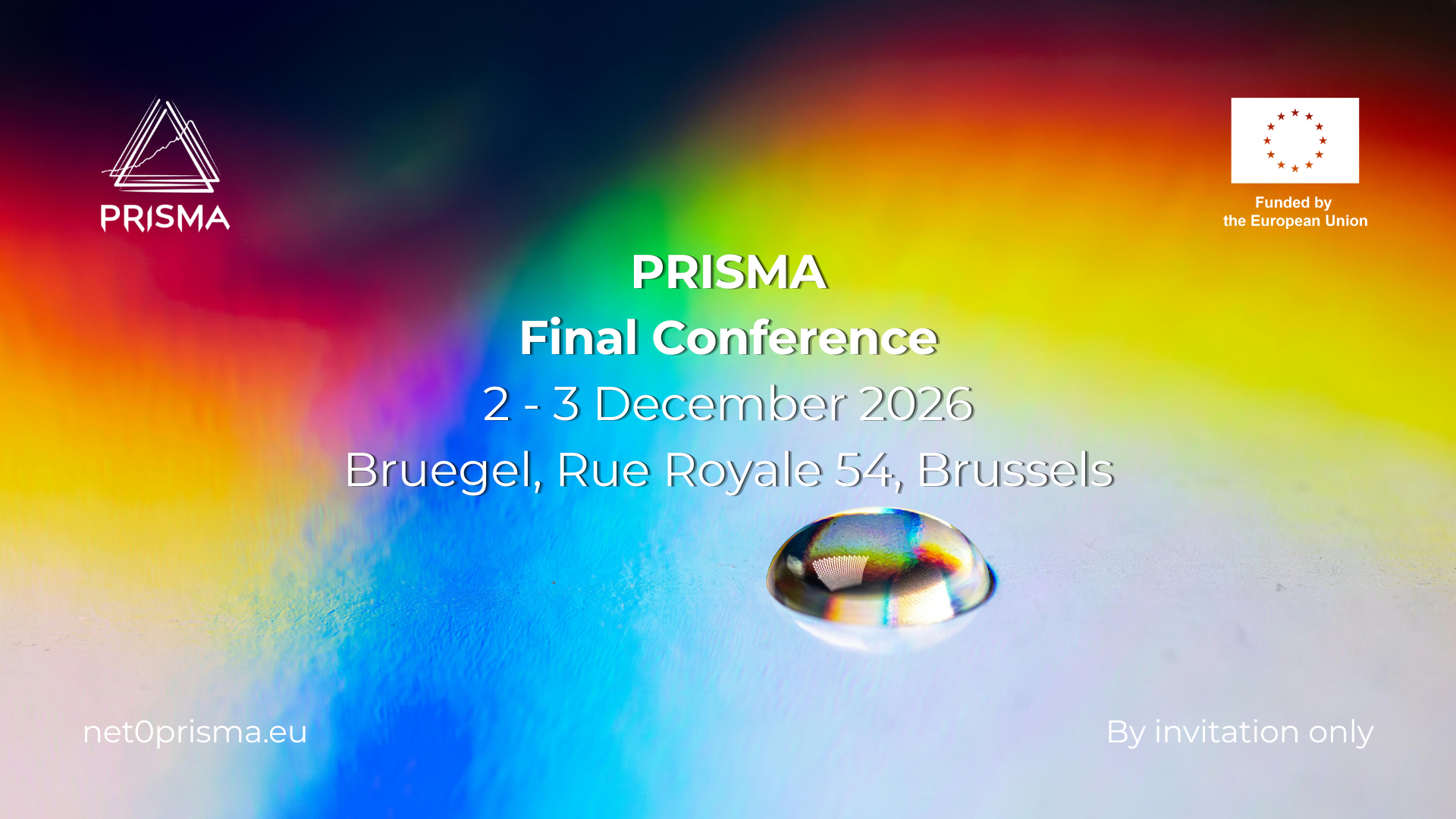
PRISMA Final Conference | December 2-3, 2026
Continue Reading: PRISMA Final Conference | December 2-3, 2026With the support of all the partners, Bruegel is organizing the final conference of the Horizon Europe project PRISMA, where key results will be presented to the participants. This project has received funding from the European Union’s Horizon Europe research and innovation programme under grant agreement No. 101081604 – PRISMA. Views and opinions expressed are…
-
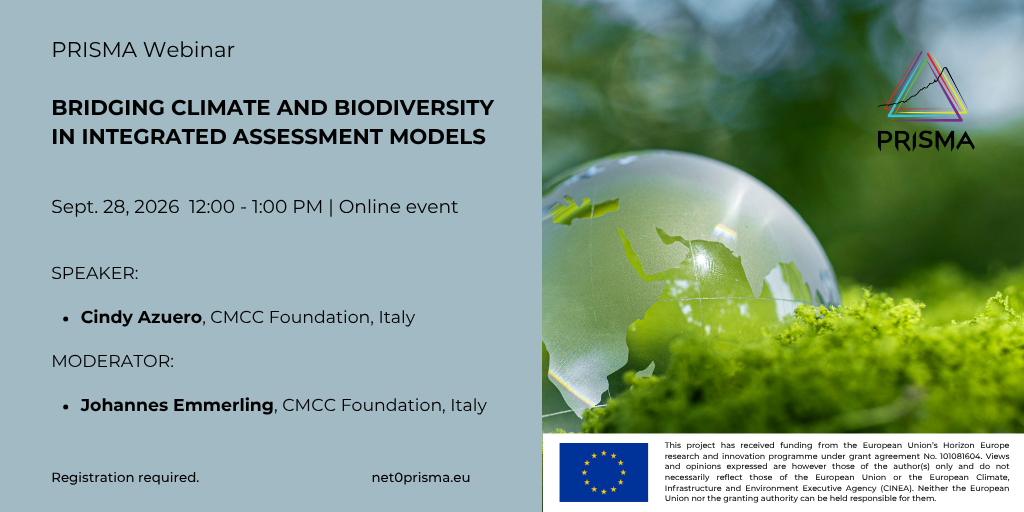
PRISMA Webinar on Sept. 28, 2026, 12:00 – 1:00 pm
Continue Reading: PRISMA Webinar on Sept. 28, 2026, 12:00 – 1:00 pmSept. 28, 2026 | 12 – 1 PM CEST The Horizon Europe project PRISMA is pleased to invite you to the next PRISMA Webinar, on Monday, Sept 28, 2026, 12 – 1 pm CEST, that explores how Integrated Assessment Models can help bridge the gap between climate and biodiversity policy. Title: Bridging climate and biodiversity in Integrated Assessment Models…
-
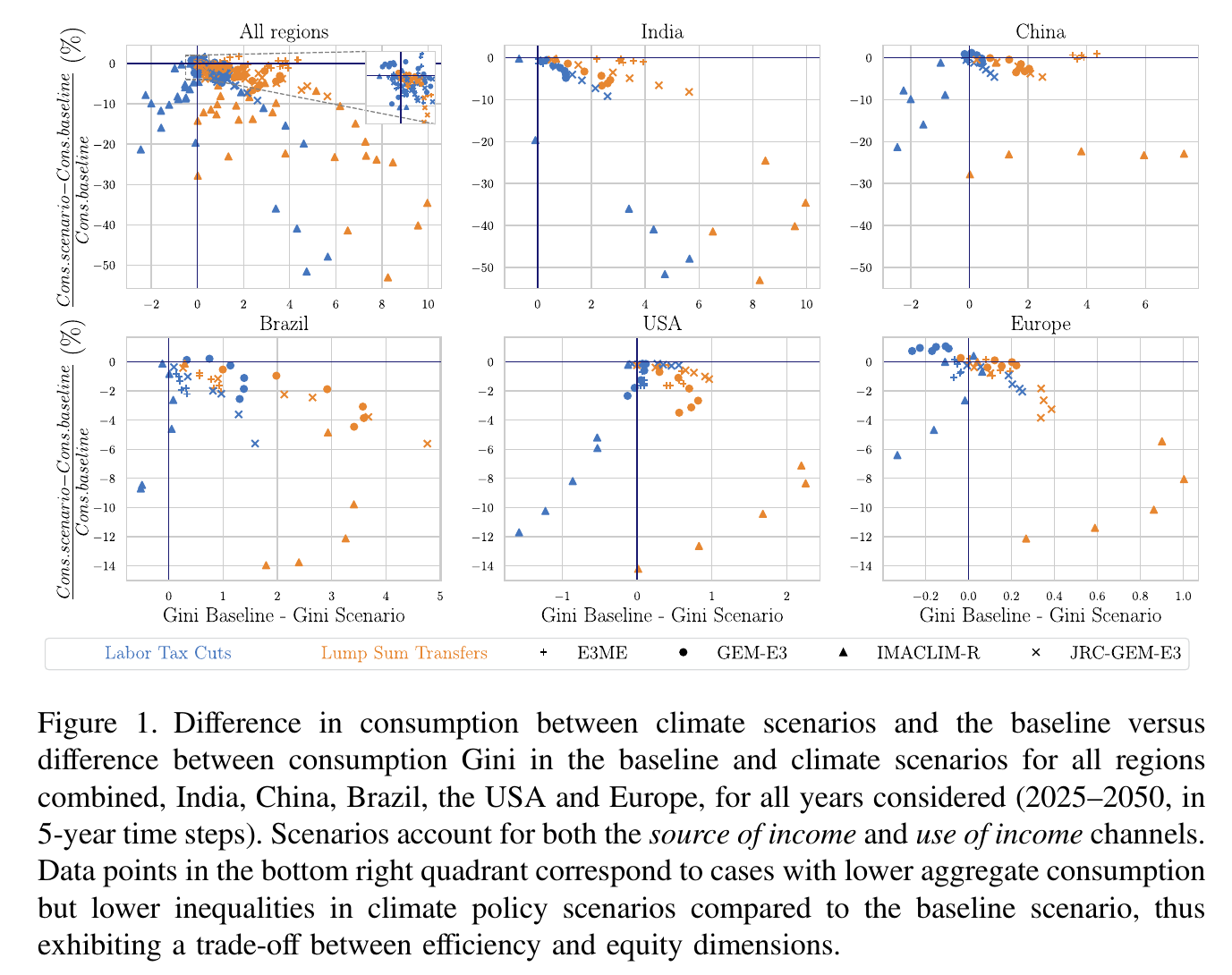
PRISMA Publication: “The Equity and Efficiency of Carbon Taxation: A Multi-Model, Multi-Country Analysis”
Continue Reading: PRISMA Publication: “The Equity and Efficiency of Carbon Taxation: A Multi-Model, Multi-Country Analysis”We are pleased to share the new paper by Aurélie Méjean, Florian Leblanc, Julien Lefèvre and colleagues, just published in Climate Change Economics. “In this paper, we investigate the distributional effects of carbon pricing, focusing on how different carbon tax revenue recycling mechanisms shape within-country inequality. We compare lump-sum transfers (equal per capita redistribution) and…
-
PRISMA @WCERE 2026: Workshop on climate-related financial risks
Continue Reading: PRISMA @WCERE 2026: Workshop on climate-related financial risksDate: Tuesday, 30 June 2026Time: 14:15 – 16:00Format: Session at World Congress of Environmental and Resource Economists 2026, Lisbon Participants: Massimo Tavoni (moderator), Oystein Borsum (Central Bank of Norway), Heather Grabbe (Bruegel Institute), Nicola Ranger (LSE), Billy Pizer (RFF), Stavros Zenios (Durham University) The PRISMA project hosted a workshop at the 2026 World Congress of…
-
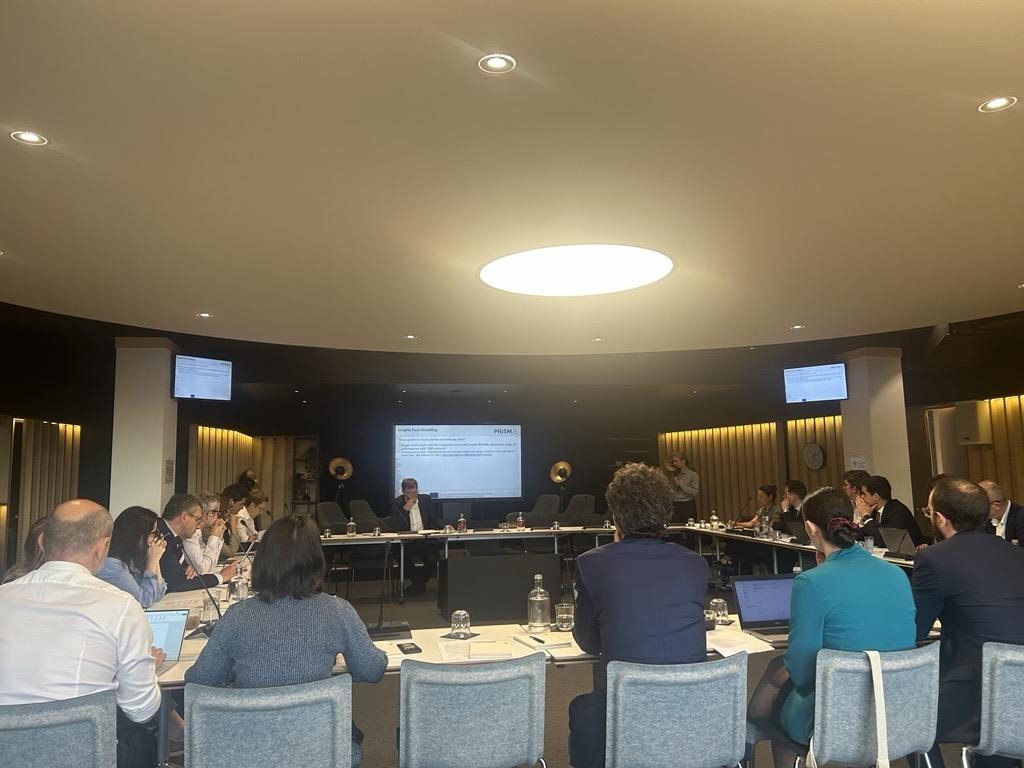
PRISMA Stakeholder Workshop on the EU’s post-2040 climate framework
Continue Reading: PRISMA Stakeholder Workshop on the EU’s post-2040 climate frameworkDate: Tuesday, 30 June 2026Time: 13:00-14:30 Format: In-person closed-door workshopAddress: Bruegel, Rue de la Charité 33, Brussels Agenda: here Bruegel hosted a closed-door workshop with researchers, think tankers, policymakers, and private sector representatives to discuss one of the central questions shaping Europe’s post-2030 climate agenda: what role will electrification play in the EU’s pathway to…
-
PRISMA Summer School 2026: Follow-up and Resources available
Continue Reading: PRISMA Summer School 2026: Follow-up and Resources availableFrom June 15–19, 2026, we gathered in Geneva, Switzerland, for an intensive and stimulating week at the PRISMA Summer School on Uncertainty in Energy and Integrated Assessment Models of Climate Change. Organised by the Renewable Energy Systems group at the University of Geneva, the school brought together 29 advanced PhD students and early-career researchers from…
-
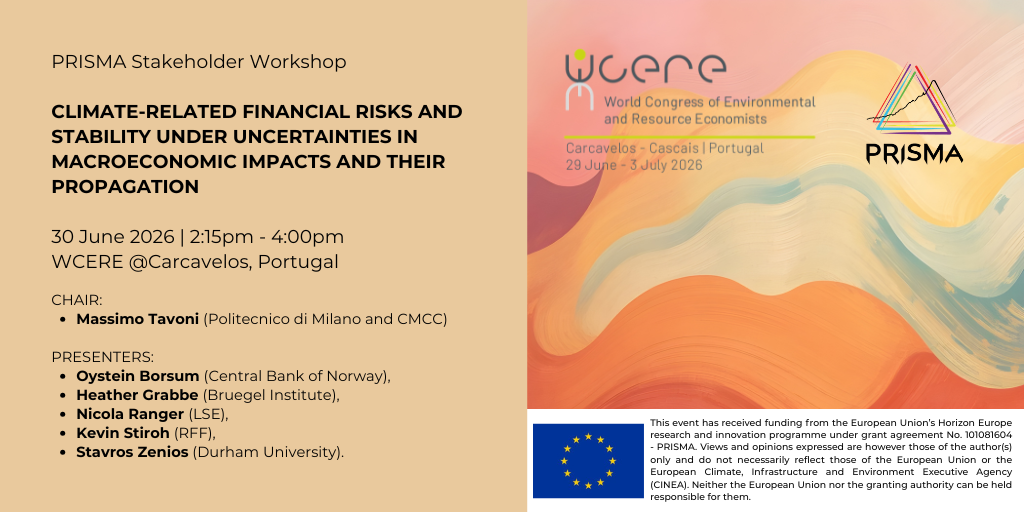
PRISMA Stakeholder Workshop @WCERE 2026
Continue Reading: PRISMA Stakeholder Workshop @WCERE 2026SPB Session: “Climate-related financial risks and stability under uncertainties in macroeconomic impacts and their propagation” Climate change and nature degradation are not just “long-run” concerns for environmental policy—they are believed to be near-term sources of financial and macroeconomic risk. However, uncertainties around the implications of climate change for the real economy and the financial markets…
-
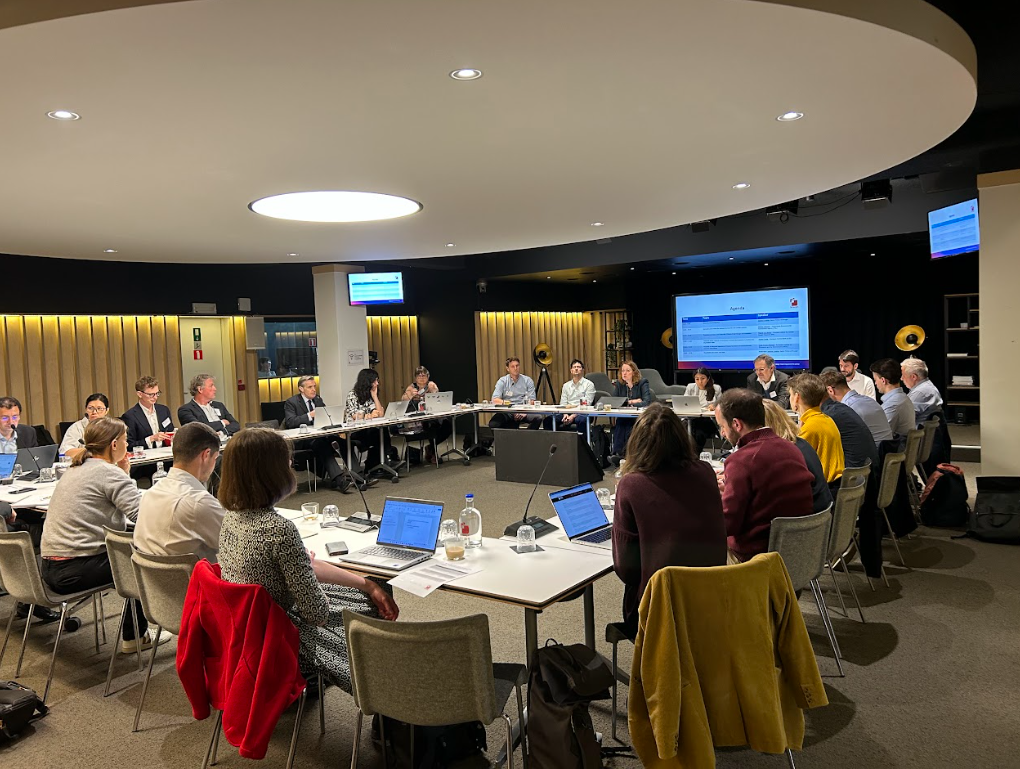
When Nature Meets Finance: Inside the PRISMA Workshop on Biodiversity, Climate, and the Financial Sector
Continue Reading: When Nature Meets Finance: Inside the PRISMA Workshop on Biodiversity, Climate, and the Financial SectorLeading researchers, policymakers, central bankers, and conservation experts gathered for an afternoon workshop on a pressing issue: what are synergies between climate and biodiversity, and what are the risks the European financial sector is exposed to. Date: Wednesday 29 April, 2026Time: 13:00 – 14:30 (with light lunch from 12:30 for networking)Format: In-person close door workshopAddress:…
-
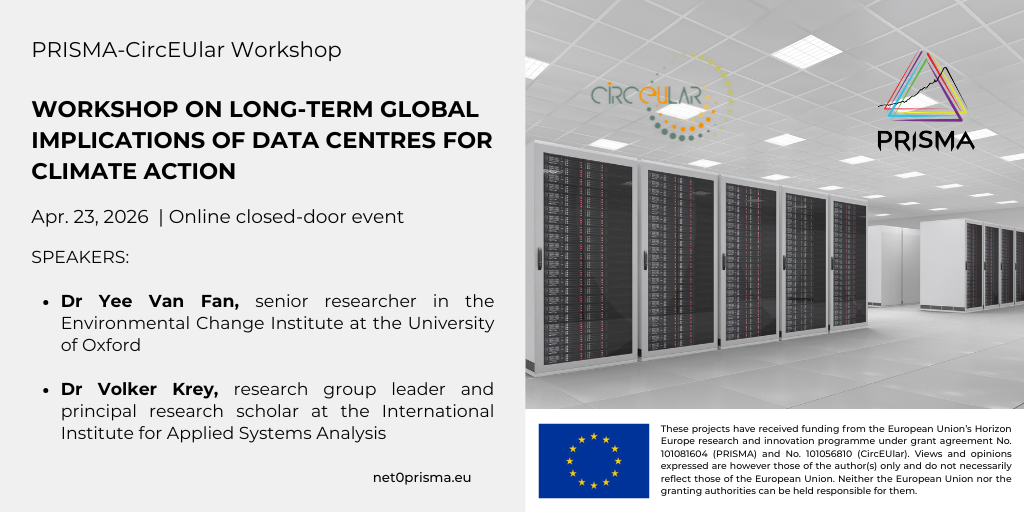
PRISMA-CircEUlar workshop on long-term global implications of data centres for climate action
Continue Reading: PRISMA-CircEUlar workshop on long-term global implications of data centres for climate actionAs part of the PRISMA and CircEUlar Horizon Europe integrated assessment modelling projects stakeholder engagement strategy, Bruegel and T-6 co-hosted an online workshop for the research stream on the long-term implications of data centres for climate action on the 23rd of April 2026, featuring presentations of recent work by Dr Yee Van Fan, senior researcher…
-

PRISMA Supports Initiative that advances EU Climate Neutrality Modelling
Continue Reading: PRISMA Supports Initiative that advances EU Climate Neutrality ModellingREMIND-MAgPIE workshop by Potsdam Institute for Climate Impact Research (PIK) The first joint REMIND-MAgPIE Workshop will be hosted from June 16th to 19th 2026 on the Telegrafenberg at the Potsdam Institute for Climate Impact Research in a hybrid format, combining in-person and online participation. The first three days will provide an overview over the (open…
-
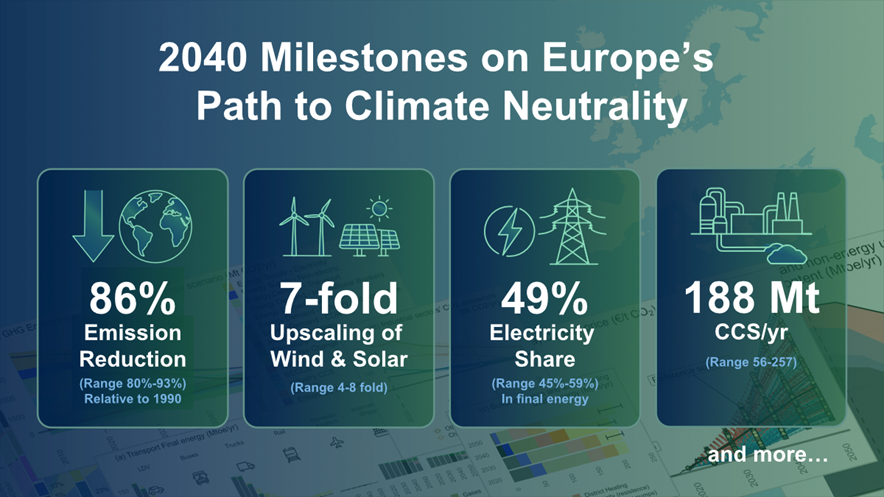
PRISMA Publication: “The 2040 milestones that Europe must meet to achieve climate-neutrality by 2050”
Continue Reading: PRISMA Publication: “The 2040 milestones that Europe must meet to achieve climate-neutrality by 2050”Renato Rodrigues, PIK The European Union has committed to climate neutrality by 2050 under the European Green Deal, but the pathway from today’s policies to that long-term goal remains highly contested. Intermediate targets are crucial because they shape investment decisions, infrastructure development, and the pace of transformation across the energy system. A new study conducted…
-
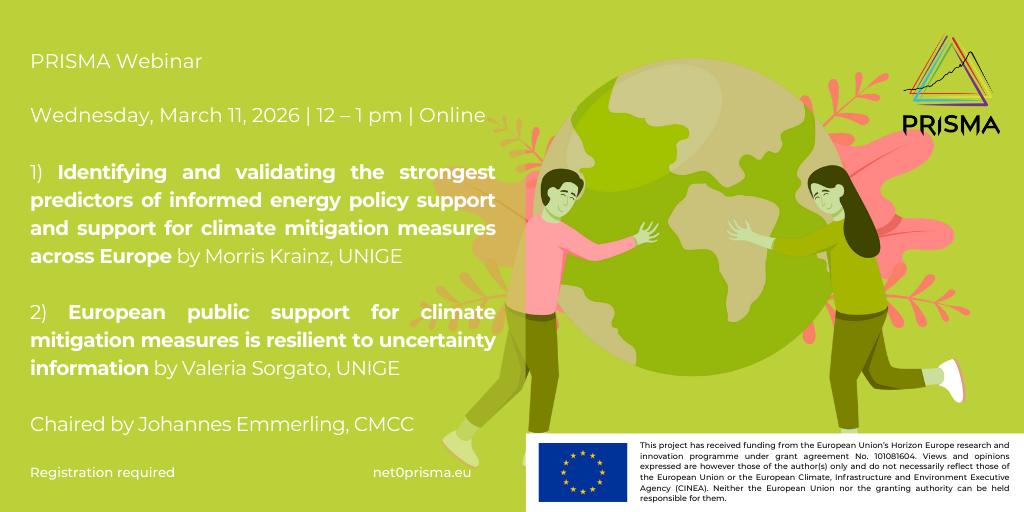
Follow up & key takeaways: PRISMA Webinar on March 11, 2026
Continue Reading: Follow up & key takeaways: PRISMA Webinar on March 11, 2026On March 11, 2026, the PRISMA project hosted a webinar on european public support for climate mitigation measures. Read below to discover more about it. Presentantion 1: Identifying and validating the strongest predictors of informed energy policy support and support for climate mitigation measures across Europe Speaker: Morris Krainz, UNIGE Key takeaways: Presentantion 2: European public support for…
-
PRISMA Summer School 2026 – CALL FOR APPLICATIONS
Continue Reading: PRISMA Summer School 2026 – CALL FOR APPLICATIONSSummer school on uncertainty in energy and integrated assessment models of climate change Organized by the University of Geneva, Renewable Energy Systems group, as part of the Horizon Europe project PRISMA and SNSF project Accuracy Uncertainty is inevitable when modeling and analyzing long-range energy and emissions trajectories to informpolicy. To support uncertainty consideration in modeling,…
-

PRISMA project meeting @IIASA, Laxenburg, Austria
Continue Reading: PRISMA project meeting @IIASA, Laxenburg, Austria“The time is gone, the song is over – and we’re in the final stretch.” In the words of Pink Floyd, the clock keeps ticking – and so does the momentum of PRISMA. Launched on January 1, 2023, and set to run through December 2026, PRISMA brings together an international consortium of research institutes, scientific…
-

PRISMA Webinar on March 11, 2026, 12:00 – 1:00 pm
Continue Reading: PRISMA Webinar on March 11, 2026, 12:00 – 1:00 pmPublic support is a decisive factor in the success of energy and climate policies. As Europe accelerates its transition toward climate neutrality, understanding what drives citizens’ acceptance of mitigation measures—and how robust that support is when faced with uncertainty—has never been more important. This PRISMA Webinar brings together cutting-edge research that sheds new light on…
-
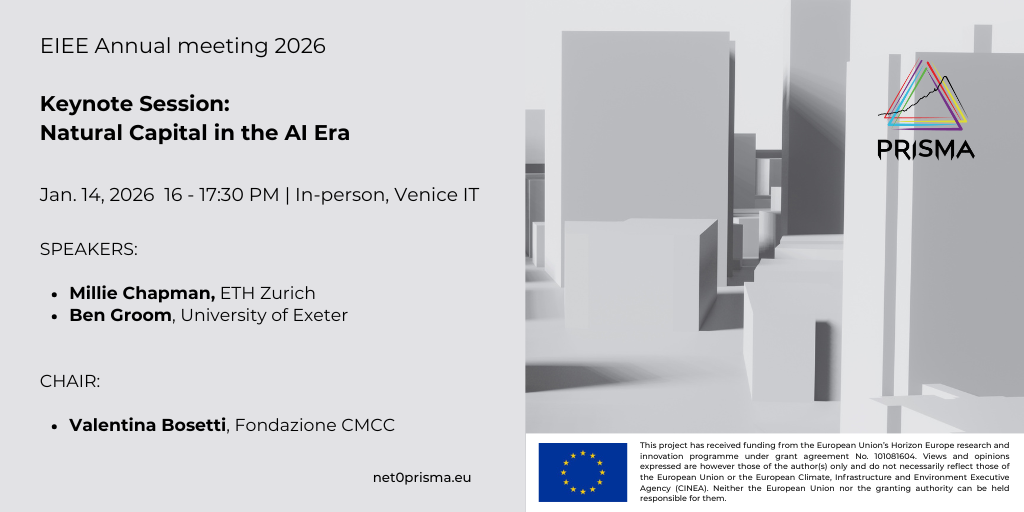
PRISMA Keynote Session: Natural Capital in the AI Era
Continue Reading: PRISMA Keynote Session: Natural Capital in the AI EraBy invitation only On 14 January 2026, a closed session titled “Natural Capital in the AI Era” took place in-person in Venice as part of the EIEE Annual Meeting. The session brought together young researchers to explore how advances in artificial intelligence are reshaping the modelling and valuation of biodiversity and natural capital in the…
-
Critical Raw Materials and the energy transition: PRISMA at the World Resources Forum 2025
Continue Reading: Critical Raw Materials and the energy transition: PRISMA at the World Resources Forum 2025How much cobalt, lithium, and neodymium will be needed to reach ambitious climate goals? Will there be enough of those materials? And how can Europe secure its supply? Such questions are gaining more and more attention from policy, industry, and research. As it has become clear that a phase-out of fossil fuels and a transition…
-
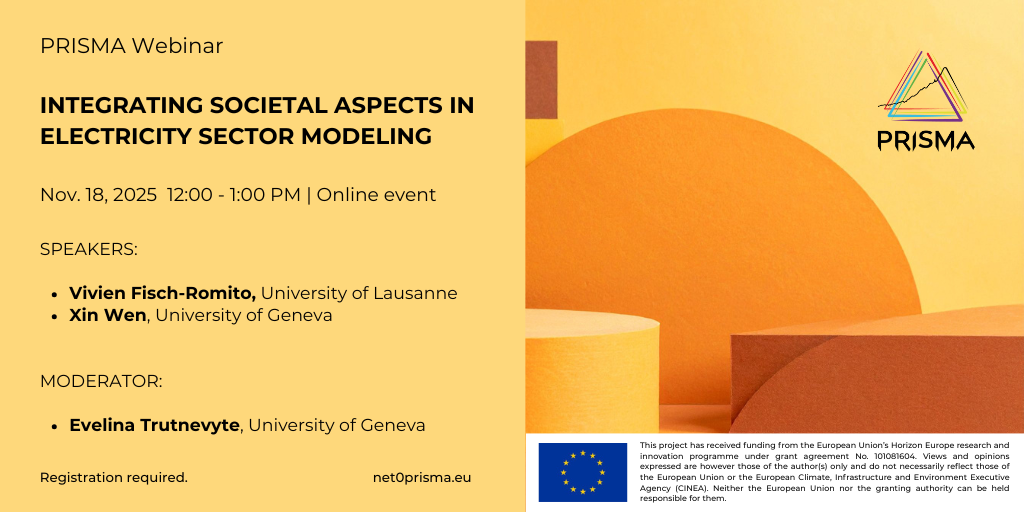
Follow up & key takeaways: PRISMA Webinar on Nov 18, 2025
Continue Reading: Follow up & key takeaways: PRISMA Webinar on Nov 18, 2025On Nov 18, 2025, the PRISMA project hosted a webinar titled “Integrating societal aspects in electricity sector modeling”. Read below to discover more about it. Key Takeaways Summary To begin with, Evelina Trutnevte presented an overview of the reasons and strategies for collaboration between modellers and social sciences. Vivien Fisch-Romito then presented the study that included…
-
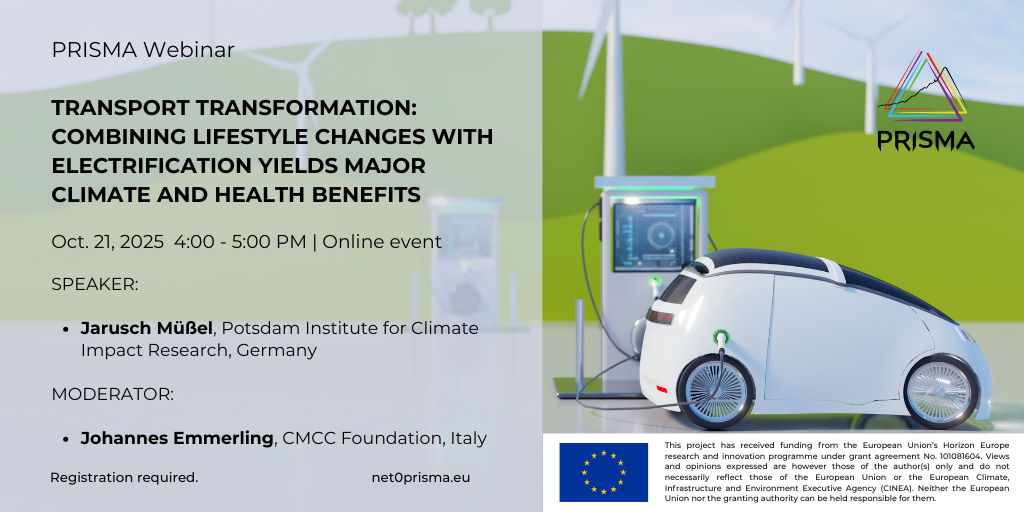
Follow up & key takeaways: PRISMA Webinar on Oct 21, 2025
Continue Reading: Follow up & key takeaways: PRISMA Webinar on Oct 21, 2025On October 21, 2025, the PRISMA project hosted a webinar titled “Transport Transformation: Combining Lifestyle Changes with Electrification Yields Major Climate and Health Benefits”. The event explored how the transport sector can be transformed to deliver not only deep decarbonization but also major health and societal benefits. Drawing on results from a recently published study using…
-
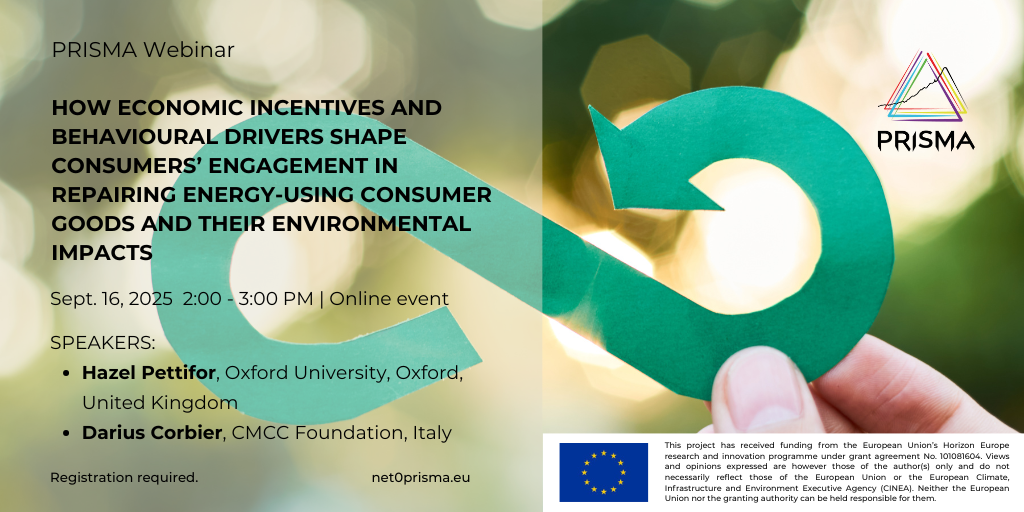
Follow up & key takeaways: PRISMA Webinar on Sept. 16, 2025
Continue Reading: Follow up & key takeaways: PRISMA Webinar on Sept. 16, 2025On September 16th, 2025, the PRISMA project hosted a webinar titled “How Economic Incentives and Behavioural Drivers Shape Consumers’ Engagement in Repairing Energy-Using Consumer Goods and their Environmental Impacts”. The event brought together experts to explore the complex factors influencing consumer repair behaviors and their implications for sustainability. Discover here the key takeaways. Summary: Japan’s…
-
PRISMA Webinar on Nov. 18, 2025, 12:00 – 1:00 pm
Continue Reading: PRISMA Webinar on Nov. 18, 2025, 12:00 – 1:00 pmNov. 18, 2025, 12:00 – 1:00 pm (Online event) Title: Integrating societal aspects in electricity sector modeling Speakers: Moderator: Abstract: Integrated assessment and energy system models are challenged to account for societal transformation dynamics, but empirical evidence is lacking on which factors to incorporate, how and to what extent this would improve the relevance of modelled…
-
PRISMA Webinar on Oct. 21, 2025, 4:00 – 5:00 pm
Continue Reading: PRISMA Webinar on Oct. 21, 2025, 4:00 – 5:00 pmOct. 21, 2025, 4:00 – 5:00 pm (Online event) Title: Transport Transformation: Combining Lifestyle Changes with Electrification Yields Major Climate and Health Benefits Speaker: Moderator: Abstract: While electrification is essential for long-term climate goals, it alone cannot unlock the full potential of a sustainable transport future. This webinar presents findings from a new study led…
-
Influenced yet resilient: acceptance of climate change solutions by European citizens in the face of uncertainty
Continue Reading: Influenced yet resilient: acceptance of climate change solutions by European citizens in the face of uncertaintyValeria Sorgato, University of Geneva We are constantly told we need urgent action on climate change. Modellers propose a vast portfolio of solutions to policy-makers, from large-scale tree planting to carbon removal technologies, to reach net-zero emissions by the end of the century. But will people accept these solutions? They may look brilliant on paper…
-
PRISMA publication: “Transport Transformation: Combining Lifestyle Changes with Electrification Yields Major Climate and Health Benefits”
Continue Reading: PRISMA publication: “Transport Transformation: Combining Lifestyle Changes with Electrification Yields Major Climate and Health Benefits”Jarusch Müßel , Potsdam Institute for Climate Impact Research (PIK), Germany Looking beyond electrification as the only means to achieve deep decarbonization in transport would bring substantial health and societal gains. A new study led by PIK researchers shows that changing mobility behavior – such as shifting to shared and active modes – can not only deliver…
-
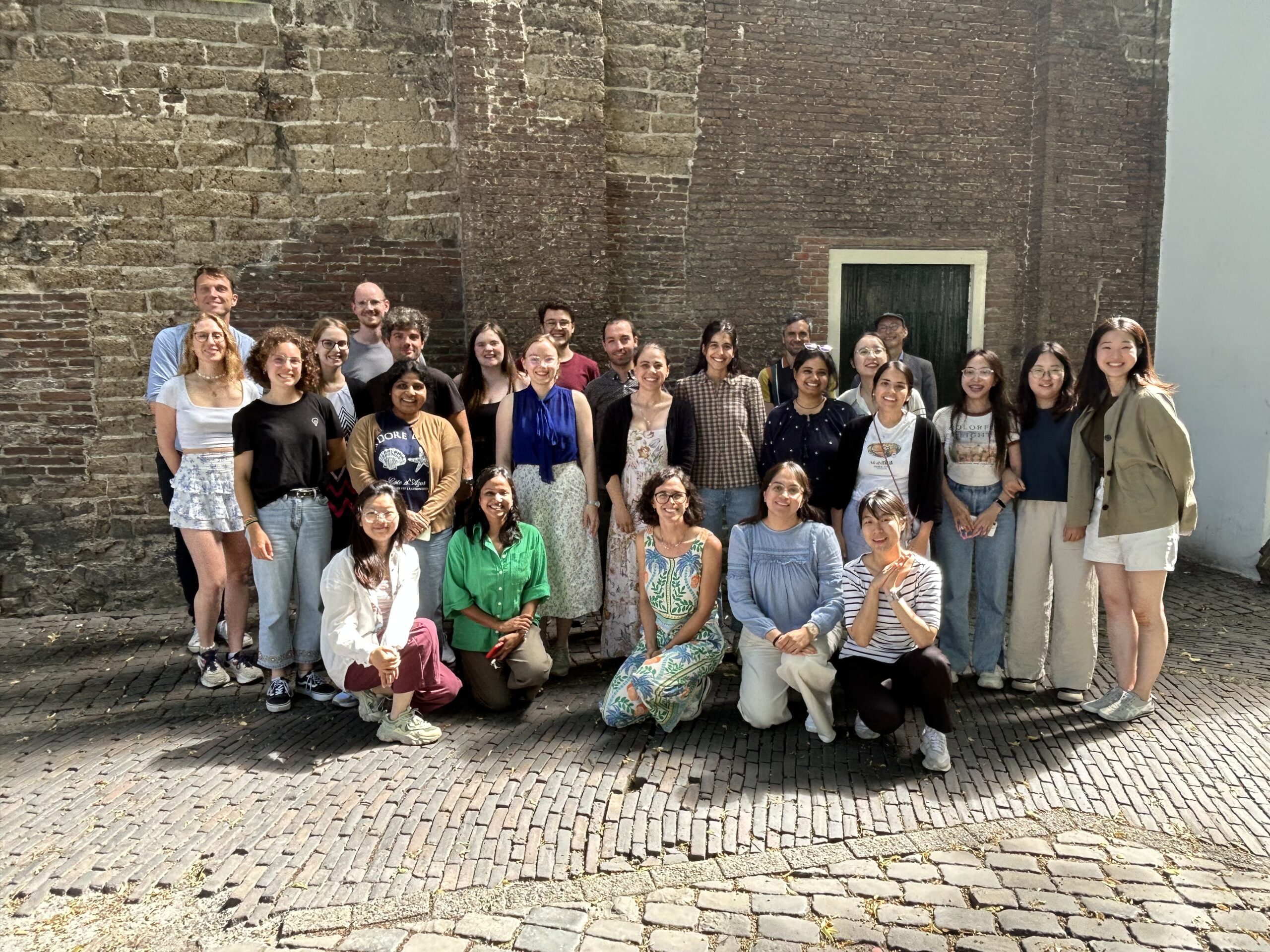
PRISMA Summer School 2025: Follow-up and Resources available
Continue Reading: PRISMA Summer School 2025: Follow-up and Resources availableFrom July 7–11, 2025, we gathered in Utrecht, the Netherlands, for an inspiring and intensive week at the PRISMA Summer School on Climate Impacts and Equity. Designed for advanced PhD students and early-career researchers working with integrated assessment models (IAMs), the week fostered critical discussions around the integration of equity, climate impacts, finance, and adaptation…
-
PRISMA Webinar on Sept. 16th, 2025, 2:00 – 3:00 pm
Continue Reading: PRISMA Webinar on Sept. 16th, 2025, 2:00 – 3:00 pmSept. 16th, 2025, 2:00 – 3:00 pm (Online event) Title: How Economic Incentives and Behavioural Drivers Shape Consumers’ Engagement in Repairing Energy-Using Consumer Goods and their Environmental Impacts Speakers: Abstract: Under the Sound Material-Cycle Society, Japan’s Reduce-Reuse-Recycle framework reduced municipal waste. Since 2010 progress has slowed while primary resource use remains high. In this seminar…
-
Shaping Just Futures: PRISMA project at the Scenarios Forum 2025
Continue Reading: Shaping Just Futures: PRISMA project at the Scenarios Forum 2025Céline Guivarch, CIRED The third edition of the Scenarios Forum took place in Leeds, UK, from 16–18 July. It brought together over 300 researchers and experts, who shared advances in scenario methods and reflected on their use in addressing the interconnected crises of climate change and biodiversity loss. Discussions covered a wide range of topics,…
-
PRISMA Summer School 2025: Work in Progress
Continue Reading: PRISMA Summer School 2025: Work in ProgressMathijs Harmsen, PBL Netherlands Environmental assessment agency In the week of 7-11 July, 2025, PRISMA project, supported by the European Union’s Horizon Europe research and innovation programme under grant agreement No. 101081604, will host a summer school for a group of highly skilled students aimed at understanding the relevant aspects of climate impacts and equity,…
-
NGFS report uses GEM-E3 Model to Quantify Short-Term Climate Policy Impacts on Global Finance
Continue Reading: NGFS report uses GEM-E3 Model to Quantify Short-Term Climate Policy Impacts on Global FinanceE3M Delaying climate transition will increase the overall economic costs of transitioning, generate material GDP losses and result in impacts to global supply chains, finds a recently launched report looking at four short-term climate change response scenarios on the real economy, labour markets, financial institutions, and the broader financial system. The first-of-its-kind report, released by Network…
-

PRISMA publication: Climate Risks Could Raise Water and Energy SDG Costs by Up to 30%
Continue Reading: PRISMA publication: Climate Risks Could Raise Water and Energy SDG Costs by Up to 30%IIASA Achieving universal access to water and energy while facing growing climate risks demands more resilient and adaptive investment strategies. A new study led by IIASA and supported by the PRISMA project highlights that climate change could significantly drive up the costs of achieving Sustainable Development Goals (SDGs) in the water and energy sectors, particularly…
-
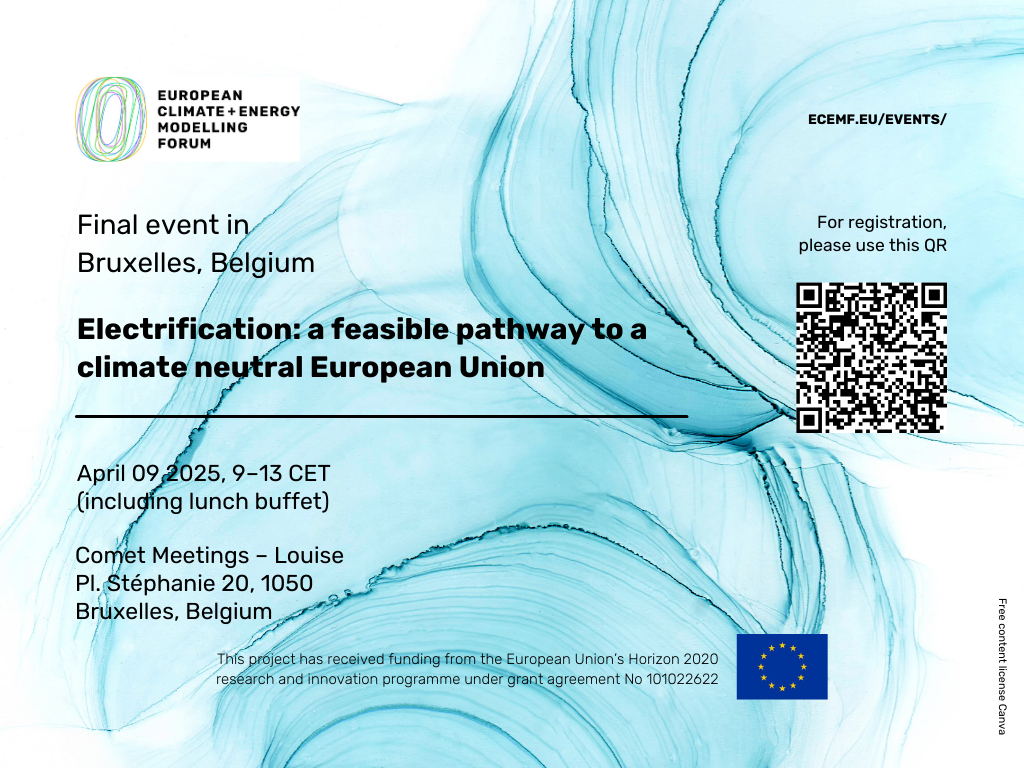
Equity and disparities in the costs and benefits of the transition – April 09, 2025
Continue Reading: Equity and disparities in the costs and benefits of the transition – April 09, 2025PRISMA is pleased to promote the final event of the project ECEMF (European Climate and Energy Modelling Forum) on April 09, 2025. This collaboration between PRISMA and ECEMF arises from the strong connection between the two projects. Several partners actively contribute to both initiatives, joining forces to advance impactful, policy-relevant climate and energy modelling across…
-

PRISMA publication: Decarbonising from home: A remote contribution to climate change mitigation?
Continue Reading: PRISMA publication: Decarbonising from home: A remote contribution to climate change mitigation?PIK The potential role of lifestyle changes in reducing energy demand is widely discussed, yet remains underexplored in integrated scenario assessments. A recent study, supported by the PRISMA project, demonstrates the significant impact of behavioural shifts on energy consumption and carbon emissions in the European residential sector. By incorporating behavioural factors into energy system models,…
-
PRISMA Summer School – Deadline extended to March 30th, 2025
Continue Reading: PRISMA Summer School – Deadline extended to March 30th, 2025The PRISMA project, supported by the European Union’s Horizon Europe research and innovation programme under grant agreement No. 101081604, is hosting a Summer School, from July 7 to 11, 2025, for young international scholars, advanced PhD students, and early postdocs, in Utrecht, The Netherlands. As climate impacts and equity become more central in policy discussions, there is…
-
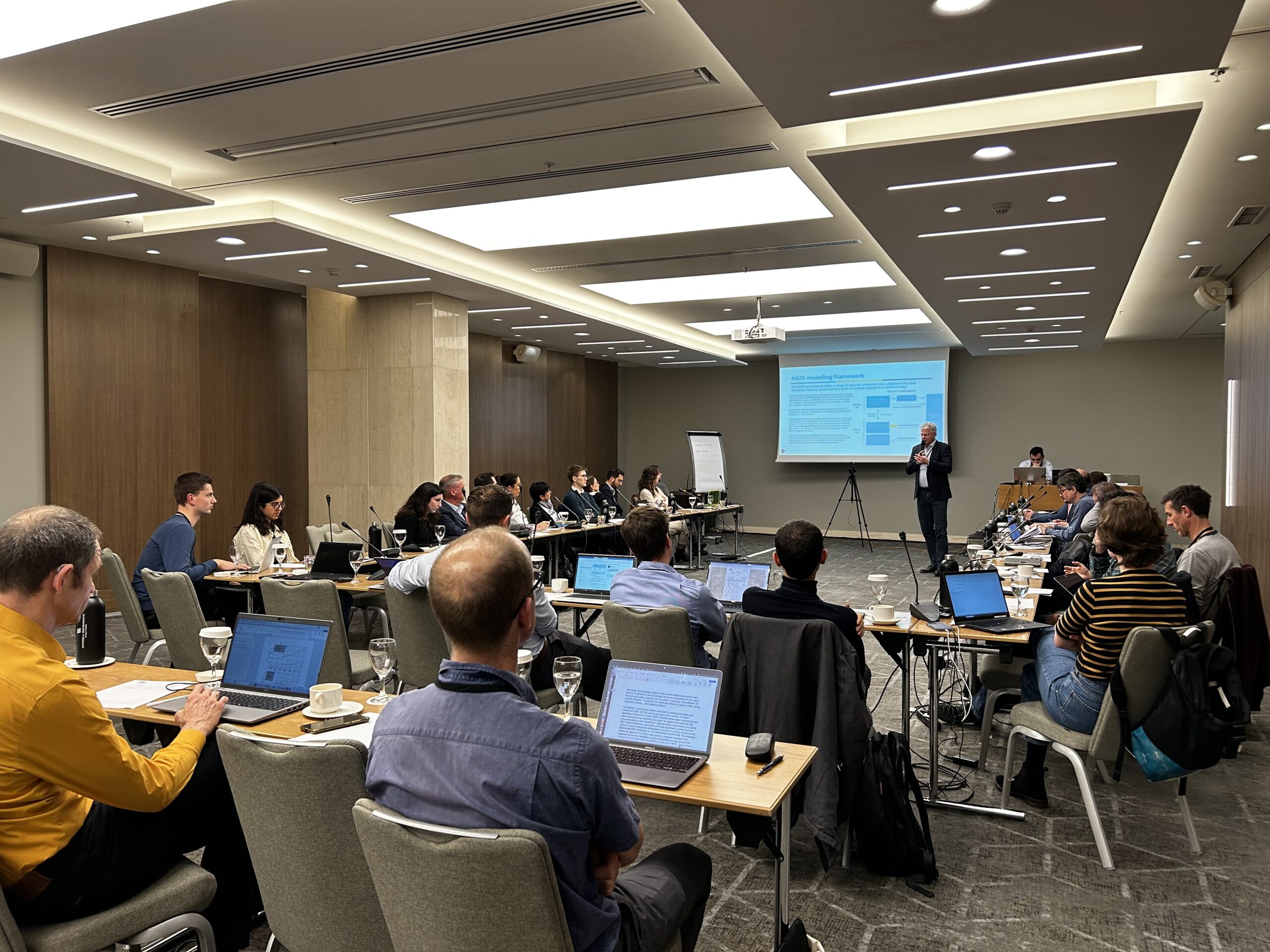
Financing the Net-Zero Transition: Key Insights from the PRISMA Workshop
Continue Reading: Financing the Net-Zero Transition: Key Insights from the PRISMA WorkshopBruegel The recent PRISMA workshop, held in Athens on January 30, 2025, brought together Greek stakeholders from finance, business, and policy sectors to discuss the critical role of financing in achieving the net-zero transition. Co-organized by E3Modelling and the PRISMA project and moderated by Bruegel, the workshop aimed to identify bottlenecks slowing down the climate…
-

PRISMA Workshop on “Financing technological cost progress to achieve net-zero” on Jan 30, 2025
Continue Reading: PRISMA Workshop on “Financing technological cost progress to achieve net-zero” on Jan 30, 202530 Jan 2025 | 14:00 – 16:30 (Athens time)Athens Despite great progress in low-carbon technologies, global investments and decarbonization efforts are still falling behind what is required. The objective of this workshop – co-organized by E3Modelling and the PRISMA project – is to identify bottlenecks slowing down the climate transition with a particular focus on…
-
How can the EU manage the risks to Europe’s 2040 climate target?
Continue Reading: How can the EU manage the risks to Europe’s 2040 climate target?Conall Heussaff, Bruegel In her mission letters to Teresa Ribera, Executive Vice-President for Clean, Just and Competitive Transition, and Wopke Hoekstra, Commissioner for Climate, Net Zero and Clean Growth, President von der Leyen emphasised the goal of enshrining a 90% emissions reduction target for 2040 into European law. This ambitious target builds on analysis from…
-

CIRCEE: The CIRCular Energy-Economy Model for Assessing Circular Economy Policies
Continue Reading: CIRCEE: The CIRCular Energy-Economy Model for Assessing Circular Economy PoliciesDarius Corbier, Junior Scientist, RFF-CMCC European Institute on Economics and the Environment As transitioning to a circular economy (CE) can contribute to the achievement of long-term climate targets, the need for models to evaluate CE policy impacts becomes increasingly important. Assessing the full potential of a CE requires a macro-level and integrated assessment approach that…
-

Empowering a Green Energy Transition Through Lifestyle Change
Continue Reading: Empowering a Green Energy Transition Through Lifestyle ChangeDr Hazel Pettifor, Senior Research Associate, Oxford University The drive to meeting the Paris Climate Agreement goals of limiting warming to below 2°C requires significant changes in how we live our lives. Yet, simulation models guiding climate policy tend to overlook a critical piece of information: our lifestyles. A recent study introduces the LIFE model,…
-
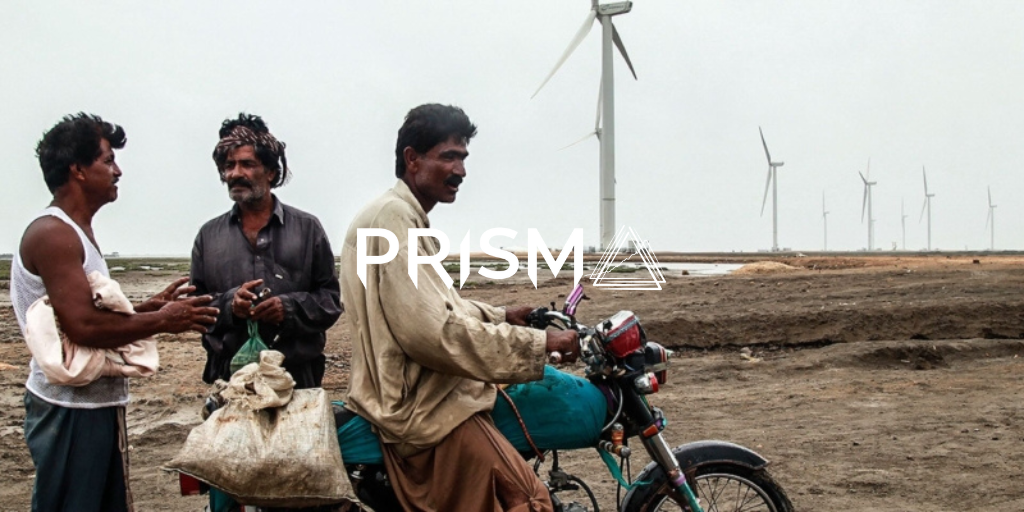
PRISMA publication: Clean energy transition – Increasing global equity with finance
Continue Reading: PRISMA publication: Clean energy transition – Increasing global equity with financeFinancing is a crucial element in the low-carbon transition as it facilitates energy availability, affordability, and equity at a global level. New research, led by CMCC scientists and sponsored by PRISMA, uses novel empirically estimated cost of capital values to show just how impactful financing costs are in the development of renewable energy sources, particularly…
-

Upcoming modelling events
Continue Reading: Upcoming modelling eventsAs we embrace summer, we want to highlight a few modelling events. The first is IAMC (4-6 November 2024), and the second is the ECEMP (16-17 October 2024). Stay tuned for more insights and developments from PRISMA project.
-
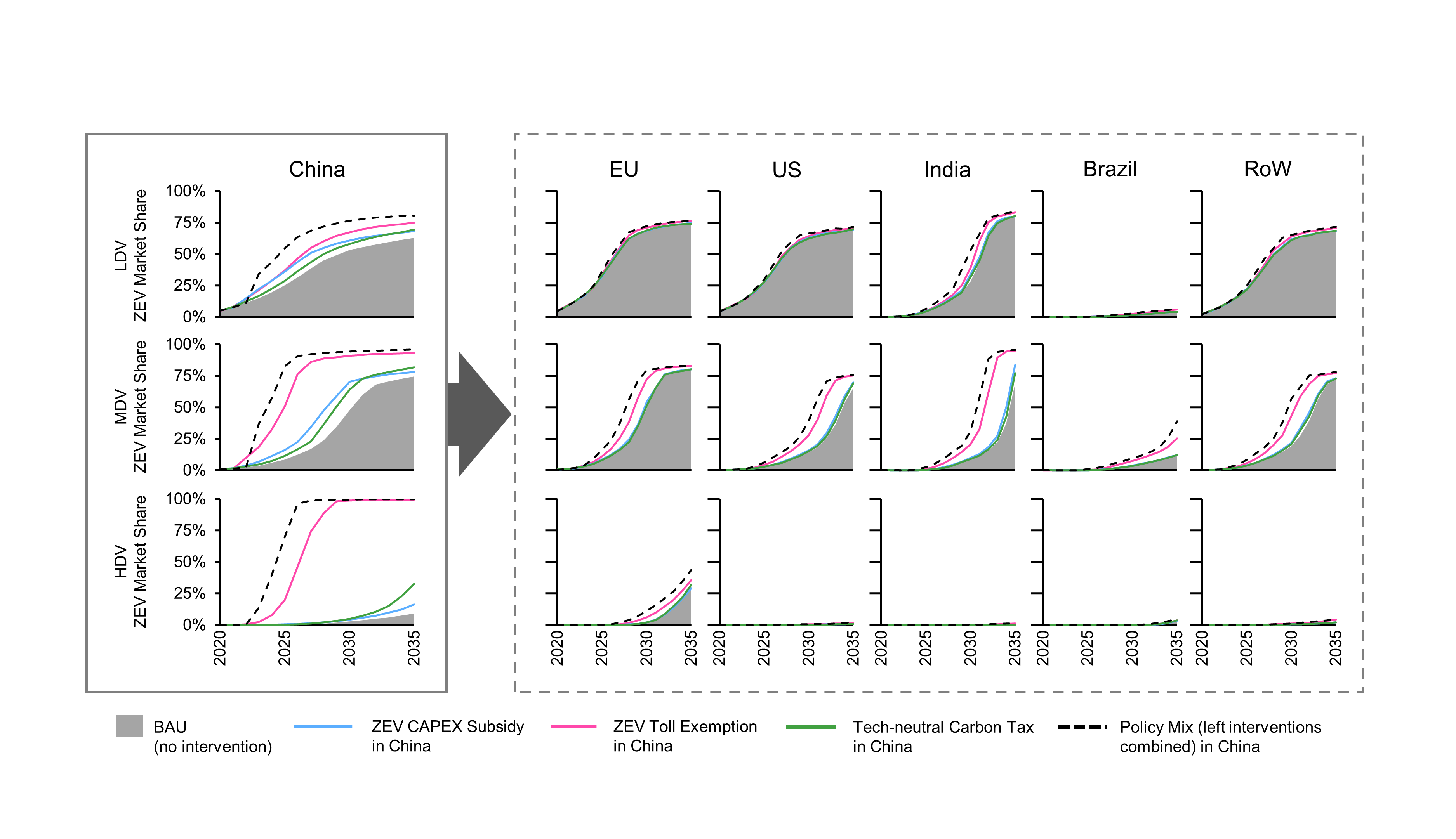
Local interventions, endogenous technological learning and deployment spillovers in energy technology projection models
Continue Reading: Local interventions, endogenous technological learning and deployment spillovers in energy technology projection modelsDr. Bessie Noll, Post Doctoral Researcher, Energy and Technology Policy Group, ETH Zürich To address global sustainability challenges, the role of policy intervention in accelerating technological change is crucial. While most policy interventions occur on the local level, their innovation effects can spill over to other jurisdictions, potentially having global impact. Our recent paper (Noll…
-

Do integrated assessment and energy models create mitigation scenarios that align with public preferences in Europe?
Continue Reading: Do integrated assessment and energy models create mitigation scenarios that align with public preferences in Europe?Valeria Sorgato, UNIGE Integrated assessment models and energy models are commonly used by decision-makers to guide policies on how to tackle climate change. These models help answer critical questions such as how to avoid surpassing 1.5°C of global warming at the lowest cost. They also help to develop detailed scenarios for transitioning electricity and whole…
-
Navigating the European Energy Transition and Climate Policy
Continue Reading: Navigating the European Energy Transition and Climate PolicyWiseEuropa Why do we need energy transition? Why do we care for climate? Can we, as a society, take the additional burden in order to protect our planet? These and many other questions will need to be answered during the ongoing campaign to the European Parliament. In the early days of June, the Europeans will…
-
PRISMA publication: First systematic review on climate change impacts on inequality
Continue Reading: PRISMA publication: First systematic review on climate change impacts on inequalityCéline Guivarch, CIRED, Ecole des Ponts In a new systematic review study, published in Environmental Research Letters, a team of authors from PRISMA analysed the existing literature and gathered evidence on whether, where and how climate change exacerbates economic inequality. The evidence from 127 peer reviewed papers shows that climate change impacts increase economic inequalities and…
-
Towards net-zero through a circular economy
Continue Reading: Towards net-zero through a circular economyPRISMA, in collaboration with fellow EU Horizon project CircEUlar, held a stakeholder workshop on 14 March 2024 titled Towards net-zero through a circular economy. The event, co-organised by Bruegel and T6, took place at Bruegel’s offices in Brussels. It brought together experts and decision-makers from industry, policy, and civil society to discuss circular strategies in…
-
Stakeholder Workshop on Citizens and Behavioural Change, on March 14, 2024
Continue Reading: Stakeholder Workshop on Citizens and Behavioural Change, on March 14, 202414 March 2024 | 12:00-16:30 Bruegel (Rue de la Charité 33, 4th floor, 1210 Brussels) Bruegel will host a closed-door, invitation only workshop, ‘Towards Net-Zero through a Circular Economy‘. The event is part of the EU Horizon Projects PRISMA and CircEUlar, which aim to integrate circular pathways in the low-carbon transition through scenario modelling. Together with T6 Ecosystems, Bruegel…
-
Sustainable Living in Systems Change: Modelling Lifestyle Change in IMAGE
Continue Reading: Sustainable Living in Systems Change: Modelling Lifestyle Change in IMAGEPRISMA hosted a research webinar on representing lifestyles in integrated assessment models (IAMs). Nicole van den Berg from Utrecht University presented a set of scenarios, called SLIM – Sustainable Living in Models – which focuses on two critical uncertainties: more individualistic or collectivist values; and more centralised or distributed support for sustainable lifestyles. Four scenarios…
-

Climate Impacts and Maladaptation in Integrated Assessment Models
Continue Reading: Climate Impacts and Maladaptation in Integrated Assessment ModelsIn a recent virtual workshop on 22nd January 2024, titled “Representation of adaptation and maladaptation in integrated assessment models (IAMs)”, attended by over 50 participants, critical discussions unfolded about integrating climate impacts and adaptation strategies in integrated assessment modelling. Chaired by Prof. Detlef van Vuuren, the event delved into recent and forthcoming efforts to improve…
-
PRISMA lifestyle webinar on January 25, 2024
Continue Reading: PRISMA lifestyle webinar on January 25, 2024Title: “Sustainable Living in Systems Change: Modelling Lifestyle Change in IMAGE” Speaker: Nicole Jane van den Berg, Utrecht University Repository Abstract: “Nicole will present part of her PhD thesis and some opportunities for the next steps. A vital part of Nicole’s thesis is the set of developed SLIM (Sustainable Living in Models) scenarios across two critical uncertainties:…
-
Stakeholder Workshop on Impacts of climate (in)action, on January 22, 2024
Continue Reading: Stakeholder Workshop on Impacts of climate (in)action, on January 22, 2024Title: Representation of adaptation and maladaptation in integrated assessment models (IAMs) Moderator: Speakers: There has traditionally been a clear divide between research communities focused on climate change mitigation and those concentrating on climate impacts. However, it is known that there are important interactions. The community scenario framework (SSPs/RCPs) is intended to facilitate such integration. In…
-
Biodiversity and Biophysical Impacts
Continue Reading: Biodiversity and Biophysical ImpactsAs part of PRISMA’s stakeholder engagement strategy, an online workshop for the research stream on Biodiversity and biophysical impacts was held on the 22nd of November 2023, featuring a presentation of recent work by Dr Johannes Emmerling, senior scientist at the RFF-CMCC European Institute on Economics and the Environment. The workshop began with an overview…
-
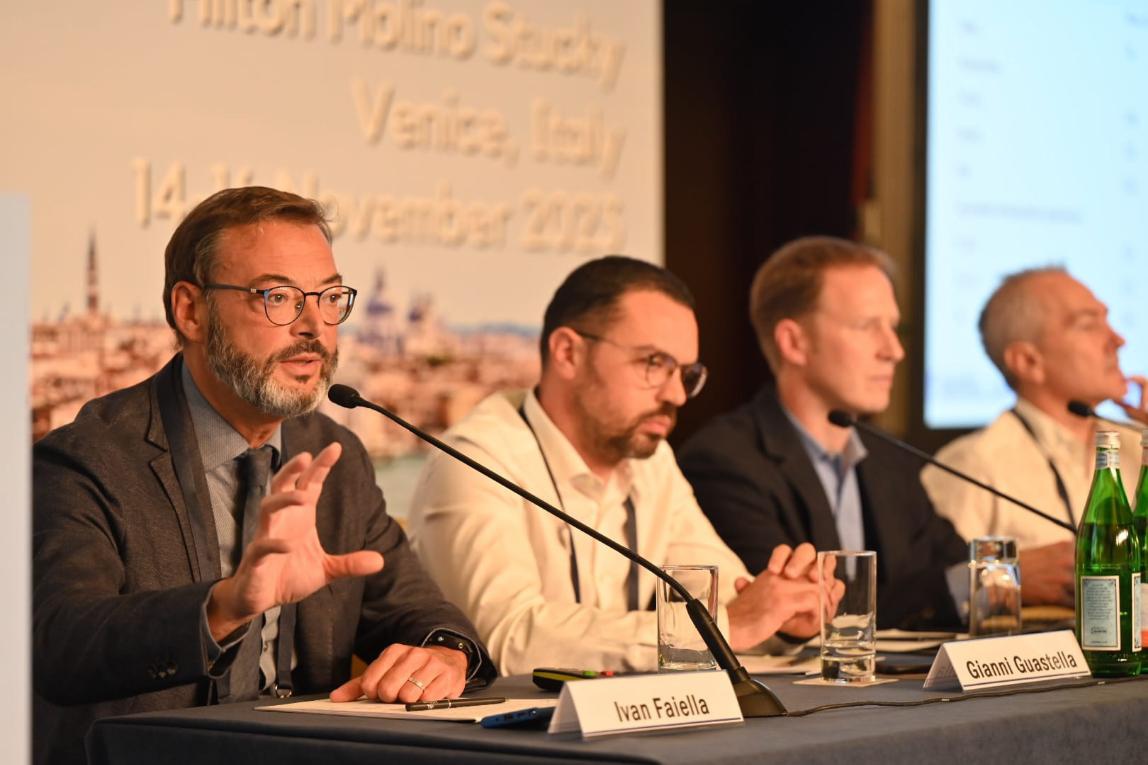
Stakeholder Workshop on Climate Finance at IAMC 2023 on “Relevance of climate scenarios for finance and private sector”, on November 16, 2023
Continue Reading: Stakeholder Workshop on Climate Finance at IAMC 2023 on “Relevance of climate scenarios for finance and private sector”, on November 16, 2023Climate finance is a central research area for PRISMA, with the project aiming to develop novel representations of macroeconomic and financial sector dynamics within integrated assessment models (IAMs). PRISMA integrates stakeholder engagement throughout its project life cycle, with stakeholder input structured through different workstreams, including climate finance. At a plenary session at the 16th Integrated…
-
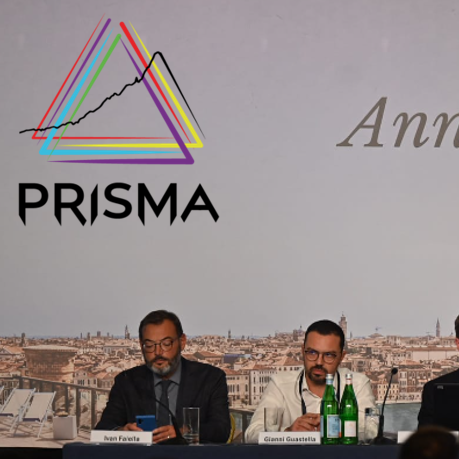
PRISMA at #IAMC2023
Continue Reading: PRISMA at #IAMC2023Plenary Session 4: Relevance of climate scenarios for finance and private sector The session exlpored how scenarios are used in the finance and private sectors. It started with a short presentation of existing scenarios produced by the IAM community. Then three scenario users discussed how they are using scenarios, how they choose scenarios, what methods…
-
Stakeholder Workshop on Biodiversity and Biophysical Impacts, on November 22, 2023
Continue Reading: Stakeholder Workshop on Biodiversity and Biophysical Impacts, on November 22, 2023Title: Climate Impacts on country-level biodiversity, ecosystems services and GDP: recent research and stakeholder views Speaker: Johannes Emmerling (RFF-CMCC European Institute on Economics and the Environment, CMCC Foundation) Abstract: Ecosystems bring benefits to human well-being, including both those with market value, that can be bought and sold, and those without, that are intangible and non-monetary…
-
Stakeholder Launch Event on “EU’s Climate targets 2040: Bridging modelling and policy”, on September 13, 2023
Continue Reading: Stakeholder Launch Event on “EU’s Climate targets 2040: Bridging modelling and policy”, on September 13, 202313 September 2023 | 12:30-14:30 Bruegel (Rue de la Charité 33, 4th floor, 1210 Brussels) The EU must declare its 2040 climate targets by the beginning of 2024, as required in the European Climate Law. To inform, justify and communicate the targets, policymakers will rely on energy, climate and economic modelling of the impacts of…
-
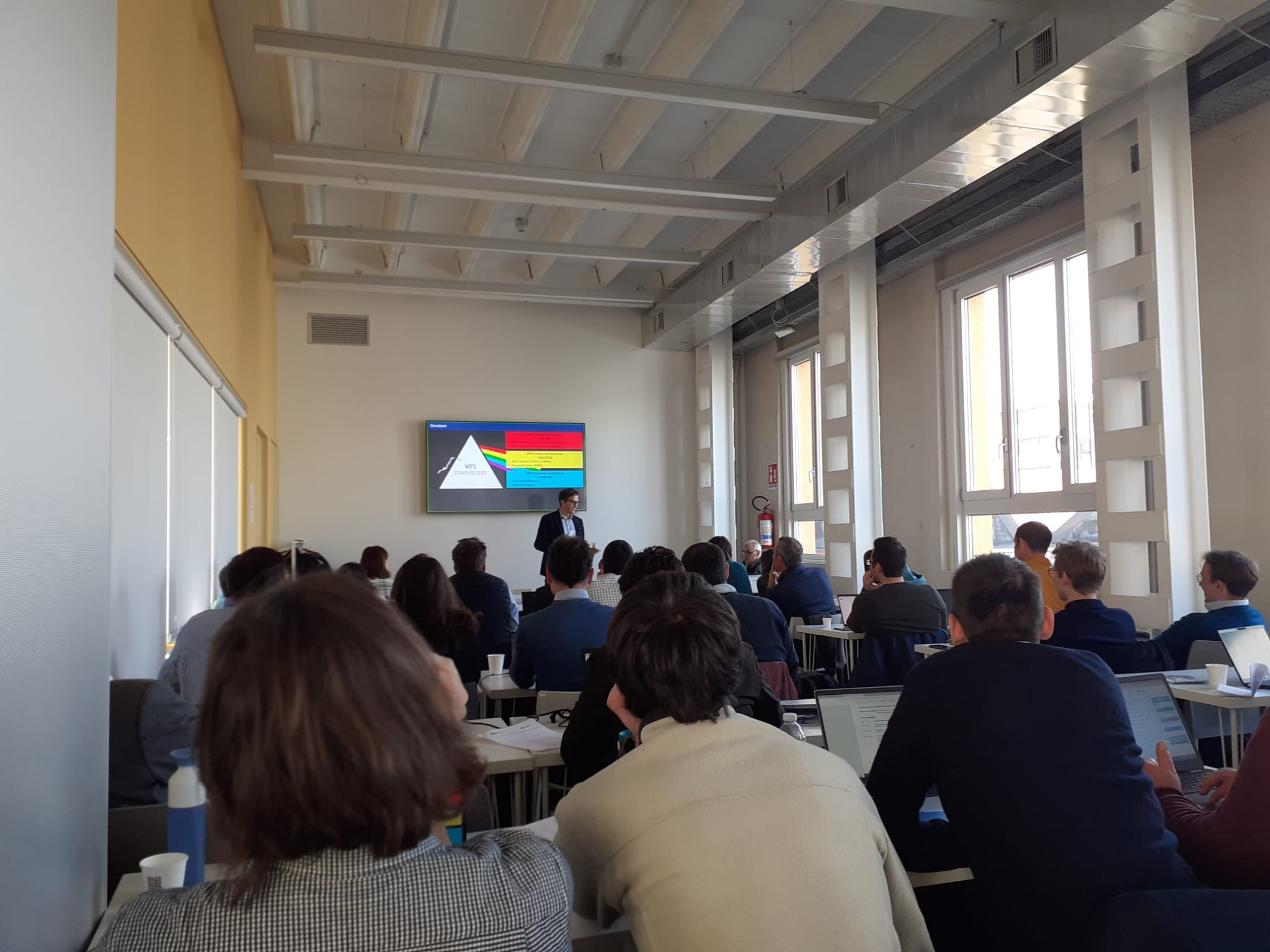
PRISMA Kick-Off Meeting
Continue Reading: PRISMA Kick-Off MeetingThe #net0prisma project aims to develop IAMs by focusing on 4 key areas of improvement, namely the representation of distributional justice and efficiency, innovation and finance, climate impacts and land-use implications, and lifestyle change and circularity. Kick-off meeting in Milan was a success: looking forward to 4 years of collaborative research! This project has received…