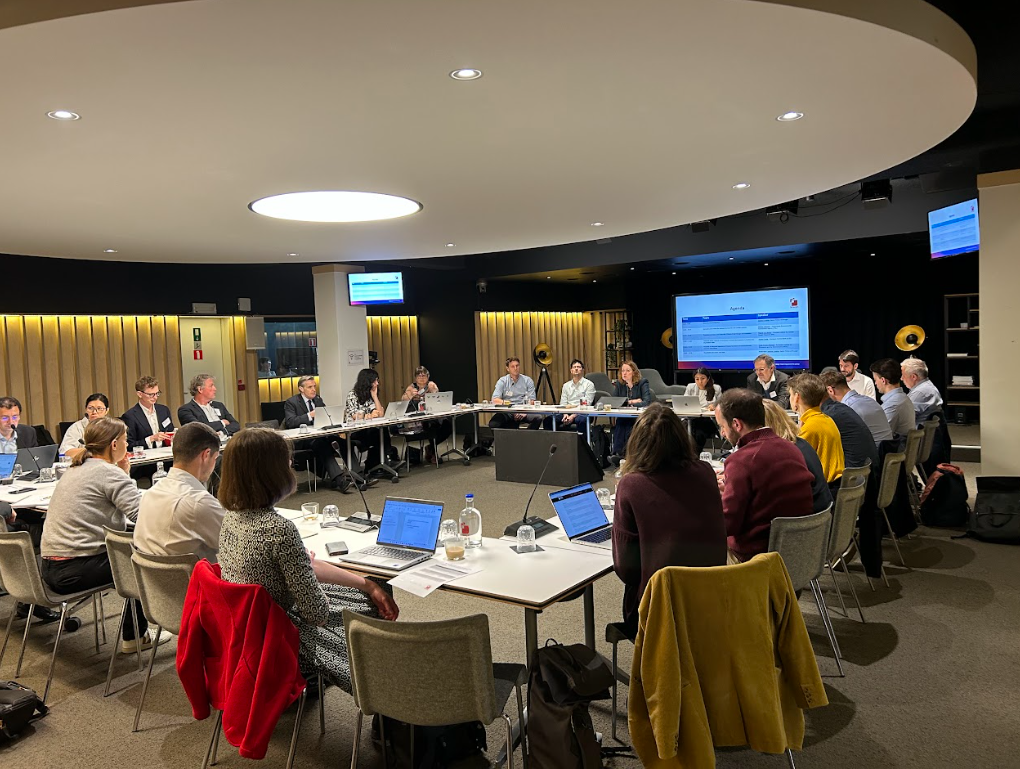
Leading researchers, policymakers, central bankers, and conservation experts gathered for an afternoon workshop on a pressing issue: what are synergies between climate and biodiversity, and what are the risks the European financial sector is exposed to.
Date: Wednesday 29 April, 2026
Time: 13:00 – 14:30 (with light lunch from 12:30 for networking)
Format: In-person close door workshop
Address: Brussels, Rue de la Charitée 33 – 4th floor
The workshop was hosted in collaboration between two Horizon Europe projects: PRISMA and CircEUlar. Bruegel Senior Fellow Heather Grabbe moderated the discussion. The session brought together over thirty stakeholders from institutions including the European Central Bank, the IMF, the Netherlands Environmental Assessment Agency (PBL), the Potsdam Institute for Climate Impact Research (PIK), and the European Commission. The goal was to identify the synergies and gaps between scientific models, financial risk frameworks.
Presentations by PBL, PIK, ECB and CMCC
Mathijs Harmsen (PBL) highlighted the differences and similarities between the biodiversity and climate policy frameworks, stressing the need for the biodiversity framework to be improved. PIK research showed that it is possible to reverse the trend on biodiversity loss while still meeting food security and climate targets but only through unprecedented, coordinated action. That means transforming food systems, rolling out ambitious conservation and restoration programmes, and simultaneously tackling climate change, invasive species, and other biodiversity threats. Patrick José v. Jeetze (PIK) showed an interesting finding: moderate diet change alone — a 50% convergence toward healthier diets by 2050 — could generate nearly two-thirds of the biodiversity related emission cuts related to biodiversity. Meanwhile, large-scale forestation, often promoted as a climate solution, carries real risks for biodiversity if not carefully managed.
Andrej Ceglar (ECB) presented work on the exposure of the financial sector on ecosystem services. European companies’ reliance on ecosystem services is significant — and largely unpriced. During the discussion it was discussed that natural capital should be treated as an endogenous part of economic models, not an externality. Firms systematically underinvest in conservation relative to what is socially optimal. Central banks and supervisors, some participants argued, have both the tools and the mandate to change this.
Cindy Azuero (CMCC) presented the capacities and limits of IAMs – highlighting in what areas IAM can contribute to answering policy questions. During the discussion it was raised that although quite some data is available, the indicators used by the financial sector, policymakers, modellers, and biodiversity experts do not always align. For example, conservation science produces indicators meaningful to ecologists; financial risk models speak in KPIs and balance sheets. The gap between these worlds is real and should be closed to influence markets and answer policy questions.
Concerning biodiversity financing. two broad schools of thought emerged in discussion. The first favours market-based instruments — voluntary schemes, incentives, nature credits. The second pushes a risk-based approach: making the financial risks of biodiversity degradation so visible and concrete that companies and banks can no longer ignore them. The two are not mutually exclusive, but currently neither is delivering at scale.
The upcoming EU Nature Credits programme and the next EU budget cycle (2028–2034) were flagged as critical policy developments for biodiversity financing. With commitments to biodiversity spending already falling short under the current MFF, the stakes for the next budget negotiations are high. A policy brief produced on biodiversity will consider discussion points raised during this workshop.
PRISMA project has received funding from the European Union’s Horizon Europe research and innovation programme under grant agreement No. 101081604. Views and opinions expressed are however those of the author(s) only and do not necessarily reflect those of the European Union or the European Climate, Infrastructure and Environment Executive Agency (CINEA). Neither the European Union nor the granting authority can be held responsible for them.