
Renato Rodrigues, PIK
The European Union has committed to climate neutrality by 2050 under the European Green Deal, but the pathway from today’s policies to that long-term goal remains highly contested. Intermediate targets are crucial because they shape investment decisions, infrastructure development, and the pace of transformation across the energy system.
A new study conducted at the Potsdam Institute for Climate Impact Research and published in Nature Communications provides EU-wide guidance with high sectoral detail on the required pace of transition to fossil-free technologies. The conclusion is encouraging: the EU Green Deal is technically and economically feasible, and it will ultimately strengthen the EU’s energy system while reducing dependence on oil and gas import crises.
The study uses the energy-economy-climate model REMIND to identify cost-efficient pathways towards climate neutrality. It builds a reference scenario based on the most plausible assumptions and systematically explores key uncertainties, including emissions reductions and energy efficiency in 2030, future cost developments of wind and solar technologies, the availability of hydrogen and synthetic fuels, and the potential for carbon dioxide removal to offset residual emissions.
What do 2040 milestones look like in a cost-efficient transition?
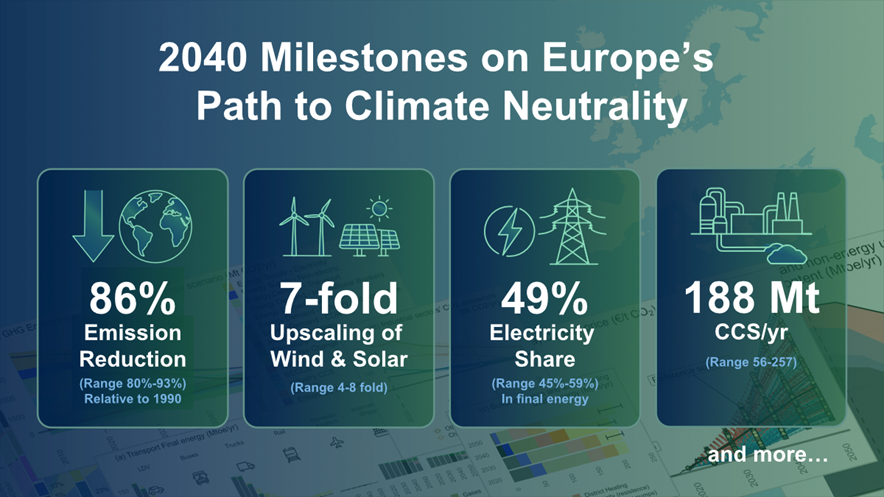
One central finding is that a cost-efficient pathway to climate neutrality requires EU greenhouse gas emissions to fall by around 86% by 2040 relative to 1990 levels under the most plausible assumptions.
To achieve such a transformation within just 14 years, the EU must build on its progress, having already reduced greenhouse gas emissions by 37% in 2024 relative to 1990, and further accelerate structural change across all sectors.
The study defines sectoral “milestones” for 2040, expressed as reference values and sensitivity ranges across robust scenarios.
Two central pillars of the transition are renewable electricity expansion and electrification of energy demand. In the reference pathway:
- Electricity generation from wind and solar must increase by a factor of seven by 2040 (range: 4-8x relative to 2018–2022).
- The share of electricity in final energy consumption rises from about 23% nowadays to 49% by 2040 (range: 45–59%).
Although ambitious, this scale-up is consistent with recent developments. The required growth rate for wind and solar expansion has already been achieved between 2021 and 2025, driven by the response to the energy crisis. Electrification is also accelerating: the share of battery-electric vehicles in EU car sales increased from 2% in 2019 to 19% in 2025, with Norway and Denmark already exceeding 80% market shares.
Fossil fuel dependence declines by around 60% in comparison to 2018–2022 levels. While alternative energy imports such as green hydrogen, ammonia, or e-fuels may still be needed, their volumes are significantly lower than today’s fossil fuel imports. This reduces dependence on external energy suppliers and strengthens the EU’s strategic energy autonomy.
The study also highlights the growing importance of carbon dioxide removal, which will be indispensable for achieving climate neutrality but remains at very low deployment levels today. Carbon capture and storage capacity must increase by 26% per year between 2030 and 2040 (range: 16-30%), reaching 188 million tonnes of CO₂ annually by 2040 (range: 56-257 Mt CO₂).
The authors conclude that the path to EU climate neutrality by 2050 remains feasible, provided that the EU now implements ambitious policies during the 2040 transition period. They argue that successful decarbonisation can make the EU economically stronger, more energy-secure, and less dependent on fossil fuel imports, while remaining cost-effective across a wide range of uncertainties.
REMIND-MAgPIE workshop by Potsdam Institute for Climate Impact Research (PIK)
- Date: June 16th to 19th (Workshop), June 17th & 18th (Stories side-event)
- Location: Potsdam Institute for Climate Impact Research (PIK), Potsdam, Germany
- Format: Hybrid (In-person and Online)
- Registration Deadlines: May 31st (Workshop), May 17th (Stories submissions)
Workshop Highlights:
- Introduction to MAgPIE Land Use Model, the REMIND Energy-Economy Model, and MADRaT Data Processing Framework
- MAgPIE & REMIND Stories Sessions: Insights from Model Users and Developers
- Insights into the REMIND-MAgPIE coupling
Useful links:
- REMIND-MAgPIE26 Workshop website: https://magpiemodel.github.io/workshops/remind-magpie26
- REMIND & MAgPIE26 Stories call for contributions: https://magpiemodel.github.io/workshops/remind-magpie26/call.html
- GitHub links: https://github.com/remindmodel/remind and https://github.com/magpiemodel/magpie
Reference:
Rodrigues, R., Pietzcker, R., Sitarz, J., Merfort, A., Hasse, R., Hoppe, J., Pehl, M., Ershad, A., Muessel, J., Schreyer, F., Baumstark, L., Luderer, G. (2026): 2040 greenhouse gas reduction targets and energy transitions in line with the EU Green Deal. – Nature Communications. DOI: 10.1038/s41467-026-71159-8 https://www.nature.com/articles/s41467-026-71159-8