
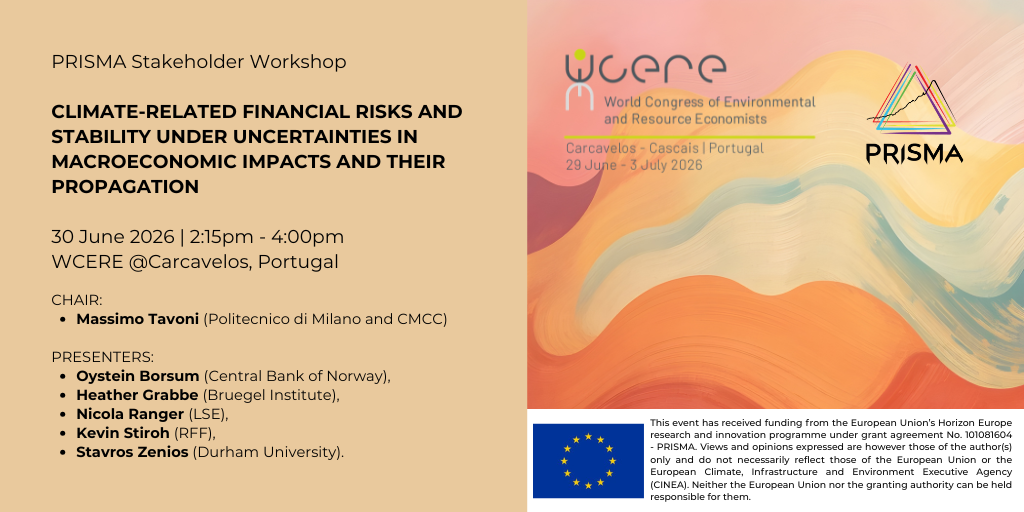
SPB Session: “Climate-related financial risks and stability under uncertainties in macroeconomic impacts and their propagation”
Climate change and nature degradation are not just “long-run” concerns for environmental policy—they are believed to be near-term sources of financial and macroeconomic risk. However, uncertainties around the implications of climate change for the real economy and the financial markets make it hard to generate precise projections of macro-financial stability under rising climate hazards. Yet, policymakers and financial institutions are in pressing need of risk policies in response to the economic and financial impacts of climate change and nature degradation.
This session will convene a panel of experts in climate financial risks to discuss the latest scientific advancements and their repercussions for policymakers and businesses. The session will discuss how physical risks (e.g., floods, wildfires, heat stress) can propagate through banks, insurers, households, firms, and sovereign balance sheets—often in ways that standard risk models struggle to capture under deep uncertainty. We will discuss possible transmission channels from hazards to balance sheets: productivity and capital damage, supply-chain disruptions, insurance withdrawal/repricing, collateral and asset-value losses, credit impairment, and fiscal pressure. The session will also discuss methodological developments for scenario generation of sovereign risks under climate hazards, in the face of deep uncertainty on the macro-economic impacts, the transmission channels to the financial system, and the role of adaptation.
For environmental and natural resource economists, the agenda of this session is central. It leverages work done by the community, including empirical and process-based estimates of the impacts of climate change and nature degradation on real and financial economy; ex-ante evaluation of macro-prudential policies to manage climate risks; scenario generation accounting for climatic and socio-economic feedbacks; decision-making under deep uncertainty. These methods can inform high-stake decisions, and will be discussed in the context of their application to finance ministries, central banks and related institutions such as the NGFS, as well as recently established academic
initiatives to bridge the gap between environmental economics research, policy engagement and the private sector.
Agenda
Chair:
- Massimo Tavoni (Politecnico di Milano and CMCC Foundation, Italy)
Presenter(s):
- Oystein Borsum (Central Bank of Norway),
- Heather Grabbe (Bruegel Institute),
- Nicola Ranger (LSE),
- Kevin Stiroh (RFF),
- Stavros Zenios (Durham University).
More info here
PRISMA project has received funding from the European Union’s Horizon Europe research and innovation programme under grant agreement No. 101081604. Views and opinions expressed are however those of the author(s) only and do not necessarily reflect those of the European Union or the European Climate, Infrastructure and Environment Executive Agency (CINEA). Neither the European Union nor the granting authority can be held responsible for them.