
Date: Tuesday, 30 June 2026
Time: 13:00-14:30
Format: In-person closed-door workshop
Address: Bruegel, Rue de la Charité 33, Brussels
Agenda: here
Bruegel hosted a closed-door workshop with researchers, think tankers, policymakers, and private sector representatives to discuss one of the central questions shaping Europe’s post-2030 climate agenda: what role will electrification play in the EU’s pathway to climate neutrality, and how should it be reflected in future targets and indicators?
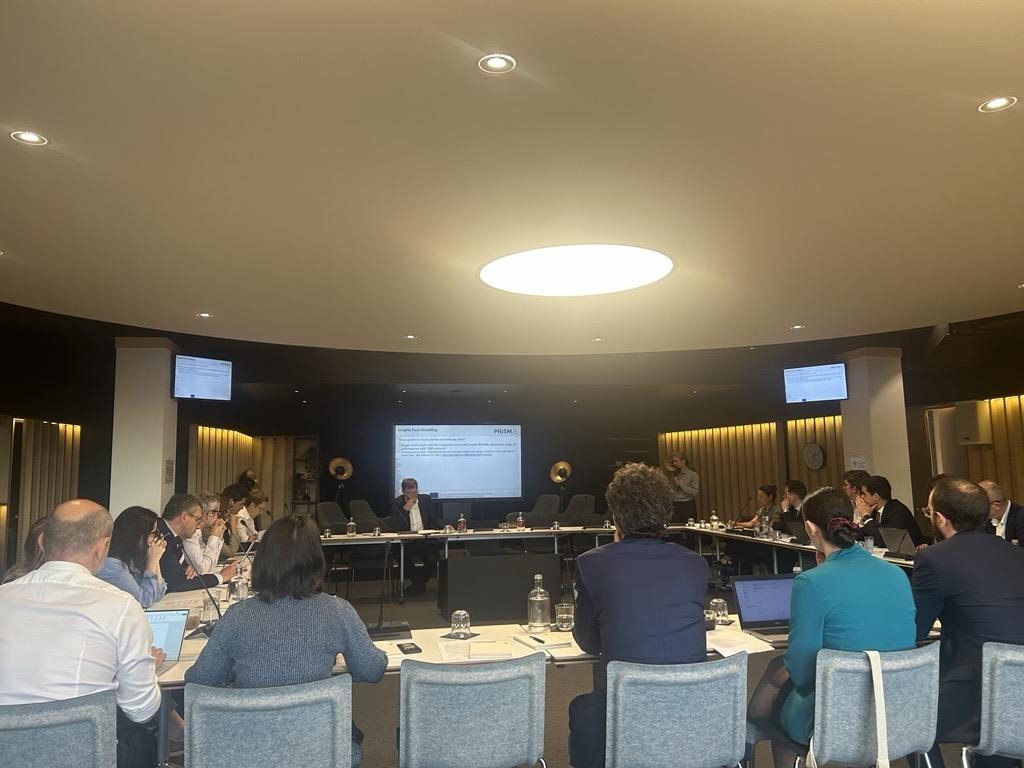
The workshop brought together stakeholders from different perspectives to discuss the future architecture of EU climate policies, including opportunities and challenges of accelerating electrification across the European economy, its links with energy efficiency, competitiveness, and the energy system transformation. The discussion explored whether an electrification target can provide an effective compass for the transition, what enabling conditions are required for its delivery, and how electrification should interact with existing climate and energy objectives.
Robert Pietzcker, Senior Scientist & Deputy Lab Leader at PIK, opened the discussion by presenting insights from modelling exercises on the pathway to European climate neutrality. While models consistently show that climate neutrality is achievable, he highlighted questions around whether an electrification target would add value to the existing framework. Electrification is a major driver of energy efficiency improvements, but some commonly used indicators, such as the share of electricity in final energy consumption, may not accurately capture progress, as they can be influenced by external factors. Participants also discussed whether absolute energy consumption targets remain the most appropriate way to measure efficiency improvements in a growing economy.
Jan Rosenow, Professor Energy and Climate Policy at University of Oxford, and Ignacio Asenjo, Team Leader System Integration at the European Commission’s Directorate-General for Energy, provided comments before the group engaged in a discussion about the EU’s post-2030 climate architecture, including the interplay between electrification and energy efficiency targets.
PRISMA project has received funding from the European Union’s Horizon Europe research and innovation programme under grant agreement No. 101081604. Views and opinions expressed are however those of the author(s) only and do not necessarily reflect those of the European Union or the European Climate, Infrastructure and Environment Executive Agency (CINEA). Neither the European Union nor the granting authority can be held responsible for them.