
We are pleased to share the new paper by Aurélie Méjean, Florian Leblanc, Julien Lefèvre and colleagues, just published in Climate Change Economics.
“In this paper, we investigate the distributional effects of carbon pricing, focusing on how different carbon tax revenue recycling mechanisms shape within-country inequality. We compare lump-sum transfers (equal per capita redistribution) and labor tax cuts across regions with different levels of economic development, using four integrated assessment models.
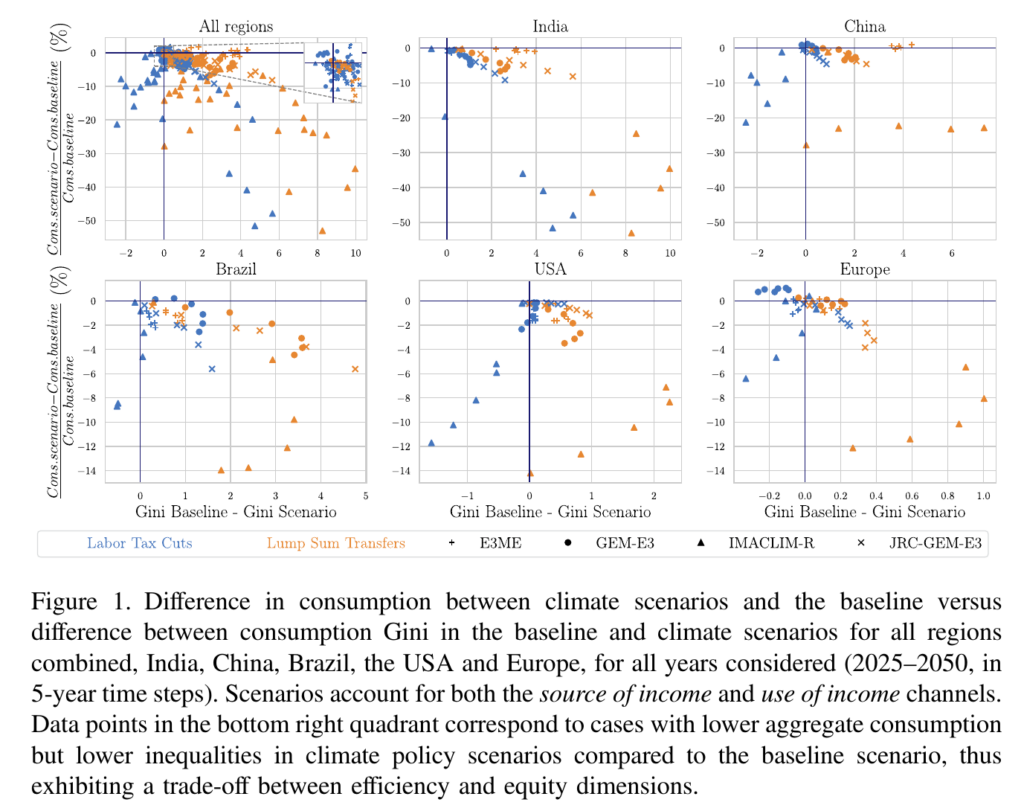
First, we find economic losses but reduced inequalities within regions in most climate policy scenarios compared to the baseline. We find that lump-sum transfers are more progressive than labor tax cuts in most cases. The progressivity of climate policy decreases with the level of economic development, and increases with the carbon intensity of economic production.
Second, we find that the progressivity of carbon revenue recycling depends on the volume of carbon tax revenues, and decreases as the carbon tax base depletes.
Third, our results show how the distributional consequences of carbon pricing depend not only on household expenditure patterns but also on structural changes affecting the share of labor income in total income, the labor share. We find that accounting for changes in the labor share substantially alters the assessment of tax revenue recycling, and narrows the performance gap between labor tax cuts and lump-sum transfers.
Overall, our findings suggest that ambitious climate policies, when combined with appropriate revenue recycling, can reduce inequality while increasing the consumption of the poorest households in many regions, particularly in low- and middle-income countries. They also underscore the importance of considering labor income dynamics when evaluating the equity implications of climate policy.”
This work contributes to ongoing discussions on the design of equitable and effective climate policies.
https://www.worldscientific.com/doi/abs/10.1142/S2010007826400105