
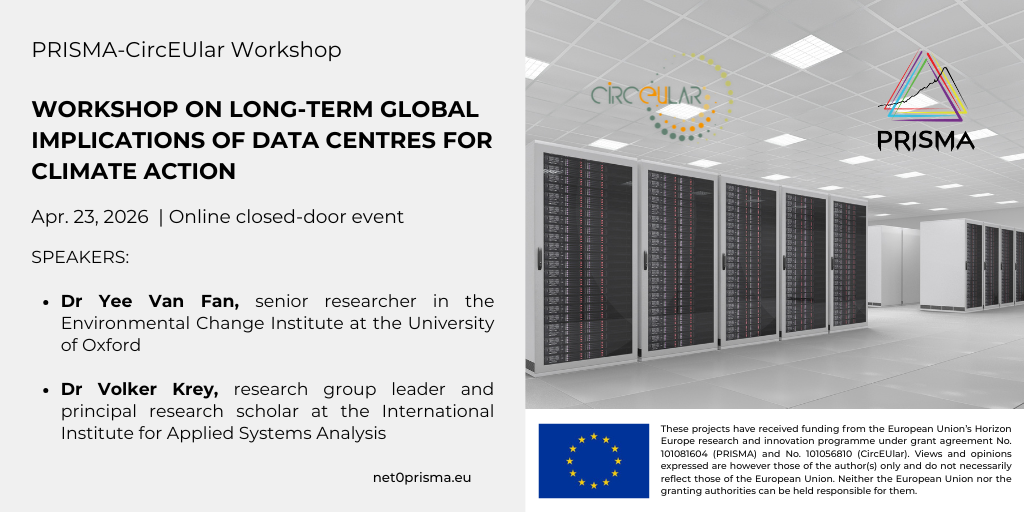
As part of the PRISMA and CircEUlar Horizon Europe integrated assessment modelling projects stakeholder engagement strategy, Bruegel and T-6 co-hosted an online workshop for the research stream on the long-term implications of data centres for climate action on the 23rd of April 2026, featuring presentations of recent work by Dr Yee Van Fan, senior researcher in the Environmental Change Institute at the University of Oxford and Dr Volker Krey, research group leader and principal research scholar at the International Institute for Applied Systems Analysis.
Input by researchers
The recent surge in data center electricity demand, driven primarily by the rapid scaling of artificial intelligence applications, has raised concerns about the energy and emissions footprint of the information and communication technology (ICT) sector. Addressing these concerns requires a longer-term perspective. While current projections typically extend only to 2030 or 2035, climate targets are generally framed around a 2050 horizon, creating an analytical gap.
To bridge this, long-term projections of data centre electricity demand were developed, rooted in historical relationships between digital transformation and energy use. The historical record reveals two distinct phases: a period of relative stability from 2010 to 2017, when efficiency improvements offset rising demand for digital services, followed by a shift from around 2020 onwards in which service demand began to outpace efficiency gains. Using these two phases to define upper and lower bounds, and combining them with five socioeconomic development pathways, the analysis produces a range of future outcomes. Under the central scenario, global data centre electricity demand could reach around 5% of total global electricity by 2050 (a roughly ninefold increase from 2020) with the full scenario range spanning approximately 1,800 to 5,000 TWh.
Under the business-as-usual scenario, future data centre electricity demand remains heavily concentrated in a small number of regions, primarily North America and Asia-Pacific. Despite not having the largest population or economy globally, North America exhibits the highest data centre electricity demand that is far above the global average (per person and per 1000 USD of GDP). In Europe, data centre electricity demand is projected to reach around 150 TWh by 2050 under the baseline, rising further under scenarios that assume convergence in both income levels and access to renewable energy. Within Europe, data centre demand is also projected to grow faster than both commercial and residential building electricity demand. The data centre projections extended to cover network infrastructure and translated into ICT demand trajectories.
Based on long-term projections of data centre and network infrastructure electricity demand, four integrated assessment models are used to explore implications of different ICT demand growth trajectories for energy demand and related CO2 emissions. A scenario set that combines the ICT demand projections with different levels of climate policy, including (i) a continuation of current policies leading to roughly constant emissions at global scale and (ii) a Paris-consistent net-zero pathway that keeps global mean temperature increase at 2℃, has been developed.
The scenario analysis indicates that the combined electricity demand of data centres and network infrastructure under the medium projection is of the same order of magnitude as the additional electrification triggered by the move from current policies to a Paris-consistent net-zero pathway by 2050, including for example the adoption of heat pumps and electric vehicles. However, even under a high growth trajectory to 2050, ICT demand remains significantly smaller than the overall growth in electricity consumption between 2025 and 2050, which is dominated by rising affluence, structural shifts towards electricity in industry, transport and buildings, and the partial decarbonization already embedded in current policies. The spatial distribution of new data centres is a key uncertainty. The current trends with heavy focus on deploying new data centres in some regions of the United States, Europe and China could continue or we may see a regional diversification with a catch up of the Global South which would have different implications for progress on climate action.
Main points raised by the audience
Discussion from participants clustered around four broad themes: modelling assumptions and methodology, infrastructure and grid integration, data transparency, and the broader policy framing of AI’s impact.
Modelling assumptions and methodology
Several questions probed the robustness and scope of the modelling presented. Participants inquired whether models account for the additional cooling loads that higher, future, climate-change driven temperatures would bring. The base case scenario showing linear growth from 2030 to 2035 was also questioned, with participants asking what drives this trajectory and what the underlying determinants of data centre demand actually are: digital transformation levels, AI adoption, or other factors. A related methodological question was how exponential improvements in AI quality and cognitive capability are incorporated, given that such improvements could significantly alter demand trajectories. It was also asked whether the Cloud and AI Development Act and the effects of adjacent sectors have been factored into the modelling exercises.
Infrastructure and grid integration
Regarding the physical integration of data centres into the energy system, participants raised questions about grid compatibility and the potential for waste heat recovery, for example by supplying it to district heating networks. In this context, the challenge of existing district heating networks typically operating at higher temperature levels compared to the temperature levels that data centres could supply was raised. A constructive suggestion was made to encourage data centre acceleration zones to be located in areas with abundant renewable energy potential. Flexibility of data centre operations was discussed as a measure to improve electricity network stability. However, it was pointed out that flexibility is challenging to implement for customer-driven applications.
Data transparency and reporting
A substantive concern was raised about the availability and quality of data underpinning both research and policy. Energy, emissions and water consumption metrics of data centres are either not disclosed by large companies or lack standardisation, and individual data centre metrics reported at the European database are currently treated as confidential under Article 5(5) of Commission Delegated Regulation 2024/1364. Participants questioned how this fragmented and limited availability of data affects the ability to make reliable projections and informed policy decisions. On the related question of Life Cycle Analysis, clarification was sought on whether this is a concrete commitment or remains an ambition. The ITU-T Recommendation L.1801 on assessing the environmental impact of AI systems was flagged as a useful reference in this space.
Policy framing and the role of AI
A perspective from the European Commission closed the discussion with a broader framing: beyond managing the risks and energy costs of AI, policymakers will also actively seek to identify the net positive impact of AI on decarbonisation and climate adaptation. This was offered as a reminder that the policy agenda is not purely about constraint, but also about harnessing AI as a tool for the green transition. As a broader remark participants highlighted that the EU policy landscape relating to data centres is constantly evolving and, if possible, this fluctuation in policies should be reflected in the modelling exercises.
PRISMA project has received funding from the European Union’s Horizon Europe research and innovation programme under grant agreement No. 101081604. Views and opinions expressed are however those of the author(s) only and do not necessarily reflect those of the European Union or the European Climate, Infrastructure and Environment Executive Agency (CINEA). Neither the European Union nor the granting authority can be held responsible for them.