What does it really cost when countries weaken or delay their climate pledges? Join us online on December 2, 2026, to find out.
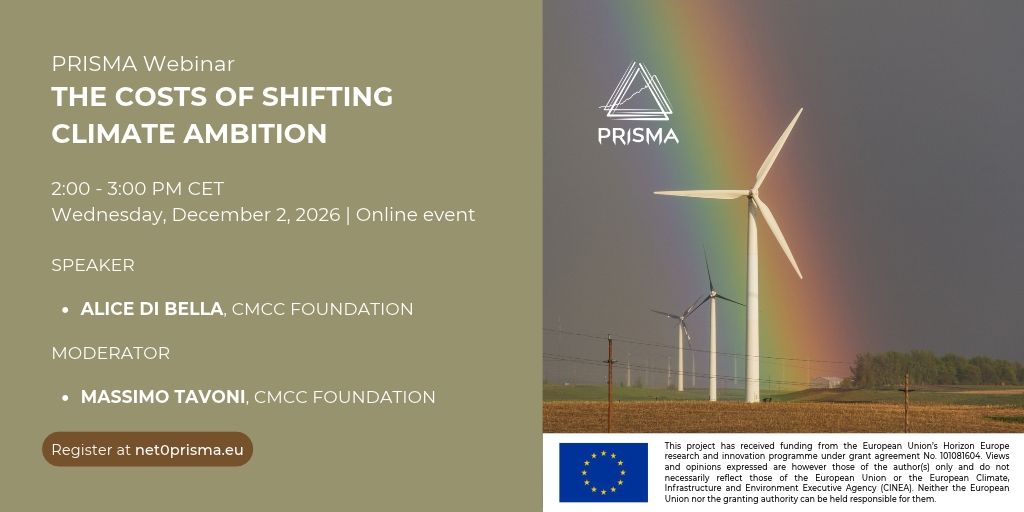
Countries are pushing their climate targets further into the future, and lowering them, at very different speeds. On December 2, 2026, from 2:00 to 3:00 PM CET, the PRISMA project invites you to a free online webinar, “The costs of shifting climate ambition”, to look at what this weakening means in practice.
Who you will hear from
- Alice Di Bella, CMCC Foundation (speaker)
- Massimo Tavoni, CMCC Foundation (moderator)
Details
- Date: Wednesday, December 2, 2026
- Time: 2:00 – 3:00 PM CET
- Format: Webinar
- Registration: https://cmcc-it.zoom.us/webinar/register/WN_QyWfGg0_SeSEtEoj9juyCA
Abstract
Climate pledges are being postponed and weakened, unevenly across countries, jeopardising long-term climate objectives. We quantify the consequences of this climate ambition weakening with seven integrated assessment models. Shifting pledges by 10 to 30 years, according to domestic economic structure, adds roughly 740 gigatonnes of carbon dioxide and raises peak warming from 2.0 to 2.4°C, putting the Paris temperature goal out of reach. The reduction in mitigation costs obtained by shifting is cancelled by climate damages within the century, leaving no global economic reason for it. What makes shifting attractive is the timing of the gain rather than its size: it arrives before mid-century, while the relevant impact of the warming it causes arrives after and is shared. Every pathway consistent with stated ambition requires decarbonisation without historical precedent. Recovering a decade later requires global emissions to fall at a pace of 2.0 GtCO₂/year for ten consecutive years, close to the largest single-year drop on record, the 2.23 GtCO₂ of 2020. Sustained clean-technology investment narrows the deployment gap but does not preserve the carbon budget.
This project has received funding from the European Union’s Horizon Europe research and innovation programme under grant agreement No. 101081604 – PRISMA. Views and opinions expressed are however those of the author(s) only and do not necessarily reflect those of the European Union or the European Climate, Infrastructure and Environment Executive Agency (CINEA). Neither the European Union nor the granting authority can be held responsible for them.